Implementation strategy to reduce environmental impact
of energy related activities in Zimbabwe
Working Paper No. 5
UNEP Collaborating Centre on Energy and Environment
Risų National Laboratory, Denmark
January 1997
Southern Centre for Energy and Environment
Zimbabwe
National Environmental Engineering Research Institute
India
UNEP Collaborating Centre on Energy and Environment
Denmark
Southern Centre for Energy and Environment
31 Frank Johnson Ave., Eastlea
P.O. Box CY 1074, Causeway
Harare
Zimbabwe
phone/fax: +263 4 737351/739341
National Environmental Engineering Research Institute
Nehru Marg
Nagpur-440 020
India
phone: +91 0712 226071 to 226075
fax: +91 0712 226252
UNEP Collaborating Centre on Energy and Environment
Risų National Laboratory
P.O. Box 49
DK-4000 Roskilde
Denmark
phone: +45 46 32 22 88
fax: +45 46 32 19 99
Contents
2 Background on the energy sector in Zimbabwe
3 Environmental impacts of energy related activities
4 Review of studies on energy efficiency in Zimbabwe
5 Barriers to implementation of negative cost options in Zimbabwe
6 Proposed implementation strategies
7 Role of multi-lateral and bi-lateral institutions/agencies in technology transfer and diffusion 63
Annex I: Evaluation of select combustion technologies
Annex II: NOx emissions from different combustion technologies
Annex III: Air pollutants from various electricity-generating technologies
Annex VI: NOx control technologies
Zimbabwe's economy has sizeable commercial agriculture, manufacturing and mining
activities. Energy consumption is relatively high by regional standards. The country has
substantial coal reserves. All petroleum products are imported. Wood fuels are widely used
by the rural households and by low income urban households as the main source of household
energy.
In view of a current economic reform programme which has opened the local market to
foreign finished products and looks to an export led economic expansion strategy, the
manufacturing sector in Zimbabwe has to become internationally competitive if it is to
hold its share of the domestic market and to gain a position on the international market.
This requires stringent management of production costs and product quality assurance.
Alongside these pressures exist pressures of rational energy use and sound environmental
management. A significant amount of cost management measures relate to energy efficiency
which has direct benefits to cost savings. Sound environmental management, however, which
has become an obvious expectation of the market can if managed proactively yield optimum
resource utilization at the shop floor resulting in cost savings. But if done reactively,
environmental management interventions normally show up as costs from which the company
sees no gains.
In the Zimbabwean situation energy efficiency management is low and proactive
environmental management is limited as companies are either not carrying out any rational
energy use and environmental management practices or are focusing on "step one"
activities such as energy and environment audits as opposed to the more sophisticated
approaches involving resource use optimization.
Energy and environmental management issues also show up on the supply side of the
equation both as costs to the economy and as negative effects on the environment. In the
past more than 12% of GDP was spent on expansion of power sector. As Zimbabwe needs energy
to raise productivity and improve the living standards, energy demand would increase in
future thereby entailing greater investment costs to the economy and perhaps expanded
environmental degradation from energy supply and utilization activities. Historically the
country's energy needs have been met by expanding the supply base with little attention
being paid to the efficiency of energy use. This approach is now, however, raising serious
financial, institutional, and environmental problems. The magnitude of these problems
underlines the need for devising strategies for improving the efficiency with which energy
is currently produced and used and the approaches adopted for sound management of
environmental impacts of the energy sector.
During this and other studies on related issues, it became evident that indeed there is
no fundamental difference of opinion and purpose among the various stakeholders on matters
of energy efficiency and environmental management. Rather, Zimbabwe is in a unique
situation where industry, government and NGOs agree on the objective of rational energy
use and sound environmental management and together have made various efforts to device
workable approaches to enhance this objective. Industry, working mostly through the
Confederation of Zimbabwe Industries' specialised committees on energy and environment,
holds consultations with Government and research institutions toward this goal. The
Department of Energy and the Ministry of Environment and Tourism's Environmental Planning
and Monitoring Unit have carried out a number of activities either through studies or
through legislative reform in light of pressure from the national consensus on matters of
energy and environment.
Despite these efforts, very little actual progress has been made in improving
industrial energy efficiency and in adopting rational environmental practices. At first
sight, it might appear that there is lack of intent but the flurry of activities in this
area do not confirm that conclusion. Rather, as the study has found out, there are some
genuine barriers to these efforts.
The study documented below focused on these barriers and on suggesting approaches to
their removal. As background and to build a context to its analysis, the study provides a
rather extensive review of the energy sector but focuses mainly on coal and electricity
and the environmental impacts of their supply and utilization.
Energy-Environmental linkages have assumed greater importance in the recent past as the
impact of green-house gases (mainly CO2) on climate change was realized.
However, in Zimbabwe, pollution has remained at a low level. Pollution assessments have
been carried out under the Ministry of Health through the Air Pollution Control Unit and
by the Ministry of Public Service, Labour and Social Welfare who assess emissions of dust
from coal as well as work place exposure to hazardous chemicals and emissions.
In 1992 UNEP-Collaborating Centre on Energy and Environment (UNEP-CCEE), Denmark and
Southern Centre for Energy and Environment (SCEE), Zimbabwe, prepared a country report for
Zimbabwe on Greenhouse Gas (GHG) Abatement Costing. Abatement technologies for both supply
side and demand side were identified in the study to reduce GHG emissions.
UNEP-CCEE's work on the Greenhouse Gas Abatement Costing Studies confirmed that for most developing countries, including Zimbabwe, scheduling GHG abatement options is likely to follow regular national development activities agenda and much less an agenda for mitigating global environmental issues. This national agenda would stress mitigation of local pollution and environmental degradation if environmental issues are at all included in the national development programme. This may mean that in the energy sector GHG emissions abatement may be achieved but only as a bonus on activities intended to mitigate local environmental problems.
As environmental issues related to energy sector are very extensive, the present study
endeavours to address environmental impacts of the entire energy cycle focusing on coal
use in industry and power generation. Zimbabwe has proven coal reserves of more than 700
million tonnes, and the potential of geological coal resources is estimated beyond 30
billion tonnes. The conventional applications of coal include electricity generation,
steam traction in railway transport, industrial boilers, tobacco curing, and coking. As
coal is the major source of energy for Zimbabwe, present study aims at identification of
environmental impacts of the entire coal cycle from mining to end-users of electrical
energy.
In view of above and the interest expressed by the Ministry of Transport and Energy in
taking up practical measures to pursue environmentally sound energy development
strategies, the present project endeavours to examine the issues which may have a bearing
on a strategy to implement sound environmental management in the energy sector.
In view of the fact that energy, like capital and labour, is a key input to production
processes, the objective of the strategy developed in this report is not to pursue energy
efficiency as an end in itself, but as a means to an end where the end includes minimizing
total costs of production as general focus.
The scope of the study, accordingly, includes:
Delineation of present sources of energy, projection of future energy demand and
collection of information on energy sector development plans.
Delineation of broad environmental impacts due to energy related activities.
Detailing environmental impact due to coal mining and coal based thermal power generation.
Development of emission scenarios for energy sector development plans.
Delineation of technological options to reduce pollution due to coal mining and thermal
power generation.
Delineation of barriers to implementation of environmentally sound energy technology.
Delineation of institutional and financial mechanism to implement the emissions
reduction measures.
Delineation of the different roles of multi-lateral and bi-lateral institutions and
agencies in the transfer and diffusion of sound energy supply and end-use technology.
Formulation of action plans for implementing strategies for minimizing negative
environmental impacts of energy related activities
The study has been jointly carried out by UNEP-CCEE, Denmark, Southern Centre for
Energy and Environment (SCEE), Zimbabwe and National Environmental Engineering Research
Institute (NEERI), India. UNEP-CCEE and NEERI experts visited Zimbabwe in January and May
1994, interacted with the government officers, industries and financial institutions to
collect necessary data. This study report has been jointly prepared by the participating
institutions.
The major limitation of the study is that it was carried out in a situation where the
present status of energy related environmental pollution is unspecified. Information on
air pollution, water pollution and land degradation due to energy related activities has
not been systematically documented. For this reason, it was not possible to assess impacts
of pollution prevention or control strategies in terms of improvements in local
environmental quality in quantitative terms due to the lack of a bench mark upon which to
judge such improvement.
Zimbabwe relies mainly on coal for thermal energy in industry and power generation.
This fuel provides the bulk of industrial energy and produces about 70% of total national
electrical energy. Electricity is also produced from hydro resources of the Zambezi.
Biomass (mainly fuel wood) is the main source of energy for rural household who represent
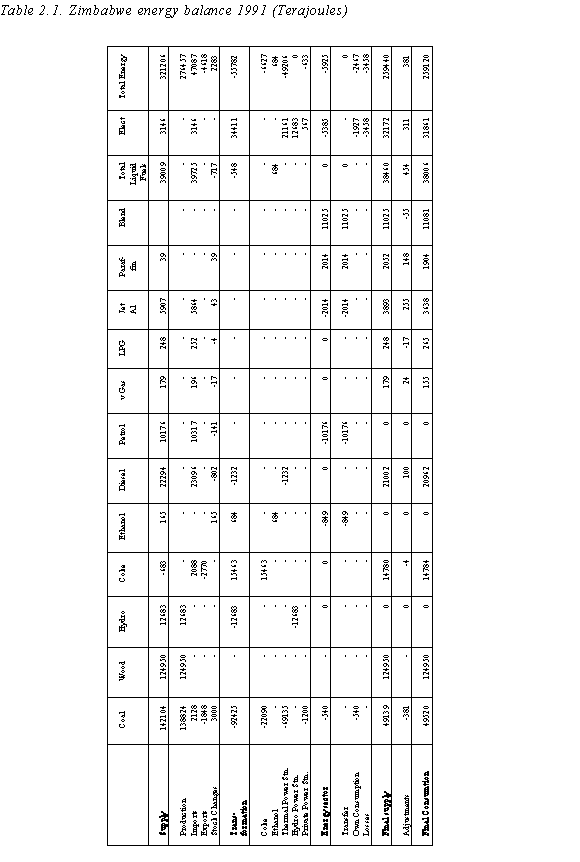
about 77% of total households in the country. The energy balance for Zimbabwe for 1991
which is shown in Table 2.1 shows a detailed breakdown of source and applications of
energy among the various economic sectors of the economy. The figures indicate the
dominance of wood in the national energy base. Wood has not been a commercial fuel in the
past but is becoming more so particularly in urban areas. All petroleum products used in
the country are imported.
Sources and applications of each of these fuels are discussed in greater detail below.
The major source of hydropower for Zimbabwe is Zambezi river which has a total
potential of 7200 MW of which 4200 MW can be developed by Zimbabwe jointly with Zambia.
The two countries share a hydroelectric power station on the Kariba dam which was built on
the Zambezi river in 1955-1960. The present total capacity is 1266 MW which was developed
as follows:
4 x 150 MW gen sets that were installed on the Zambian side and commissioned in 1962.
These sets which are known as the North Bank Power Station are shared equally between
Zambia and Zimbabwe giving each country a 300 MW share of the station.
6 x 110 MW gen sets which were installed on the southern bank (the Zimbabwe side) of
the river in 1976-77 and are known as Kariba South Bank Power Station. This later
installation brought the Kariba dam's hydro-electric power capacity to 1266 MW and under
the equal share agreement, Zimbabwe owns 633 MW of this capacity.
The Kariba Power Station has recently been affected by drought and the flows into the
lake have been progressively low since the early eighties, resulting in a critical fall in
levels which almost rendered the station in-operable in 1992/93. In August 1993, the lake
level was about one meter above the power station intake level and projections were
putting the water to last till November 1993. The drought resulted in change of preference
towards thermal plants which are less affected by poor rains. The Zambezi offers
additional hydroelectric resources at Batoka gorge, Devil's gorge, Mupata gorge and at
Cahora Bassa in Mozambique. The potential hydroelectric resources are shown in Table 2.2.
Sites for mini hydro plants in Zimbabwe have been assessed but the total potential has not been stated. Table 2.3 shows some of the potential sites and their capacity based on historical performance of their hydrology.
Table 2.2. Potential hydroelectric resources on River Zambezi
| Site | Capacity, MW |
| Batoka Gorge Devil's Gorge Mupata Gorge Cahora Bassa |
1600 1240 1000 2000 |
| Total | 5740 |
Source: ZESA
Table 2.3. Potential mini-hydro sites in Zimbabwe
| Site | Capacity, MW |
| Bangala Kyle Siya Odzani Smallbridge Manyuchi II Ruti Palawan Mwenge II Jumbo |
800 1500 450 60 70 170 200 170 100 30 |
| Total | 3550 |
Source: DOE study on hydroelectric potential of irrigation dams.
Zimbabwe has a total of 10.6 billion tonnes of coal in situ in 21 deposits. Coal
deposits occur in the younger rocks at the northern and southern edges of the basement
shield. Proven reserves can last for 107 years and total reserves over 2000 years at
present production rate of 4.7 million tonnes per year (TPY). A breakdown of coal reserves
in the country is shown in Table 2.4.
Table 2.4. Coal reserves in Zimbabwe
| Proven reserves Estimated reserves Total reserves including probable |
0.502 bn tonnes 2.000 bn tonnes 10.600 bn tonne |
Source: DOE/ESMAP
The country has two coal mines. One is the Wankie Colliery with production capacity of
6 million tonnes per year. Of the present output of 4.5 million tonnes per year, 2
million tonnes are processed and sold as industrial washed or dry coal and 2.5 million
tonnes are used as run-of-mine steam coal at the Hwange power plant. The second mine is
the Sengwa Coal Mine with production capacity of 200,000 TPY which was shut down after two
years of operation due to viability problems. The mine produced low-sulfur, low-phosphate
metallurgical coal for the smelting industry, to displace import of high quality coal from
South Africa. Wankie coal has 2.5% sulphur compared to Sengwa coal with 0.5% sulphur. Both
types of coal have an average calorific value of about 27 MJ/kg.
Wankie colliery has both surface and underground works. Proven reserves at Wankie are
302 mn M.T. (185 mn M.T. of steam coal and 117 mn M.T. of coking coal). Out of these 240
mn M.T. are open-castable. The surface mine produces a low quality high ash content (25%
ash) coal from the top of the seam. This coal is termed the HPS (Hwange Power
Station) coal and is used entirely for the Hwange Power Station. Coal
with an ash content of 35% to 40% is rejected as waste. The lower part of the seam
produces higher quality steam coal, less than 16% ash, which is supplied to industry and
agriculture. The bottom of the seam produces coking coal which is used for supplying to
the coke ovens at the colliery and at ZISCO, a steel smelter. Underground coal is produced
for blending with the coking coal in the processing plant. Underground coal has a sulfur
content of about 3% but has a low phosphorous content which makes it suitable for the
ferrochrome industry. The coal has a heat value of about 28 MJ per kg. The underground
mine produces 15% of the total colliery output and it is planned to increase output by
mechanizing. Proven coal reserves at Sengwa are 200 mn M.T. which is totally
open-castable.
Coal-based thermal power generation assumed an important role in energy supply scenario
of Zimbabwe since 1984 when Hwange Power Station was built at the Wankie coal mine. At
present, Zimbabwe has an installed coal based thermal capacity of 1295 MW with a total
annual coal intake of 2,856,673 tonnes a year in 1990-91. The role of coal in power
generation is highlighted in Table 2.5. The details of present installed capacity and
power station performance are presented in Table 2.5 and 2.6.
Table 2.5. Role of coal in power generation
| Fuel/source | Power generation, MWh | |||
| 1988 | 1989 | 1990 | 1991 | |
| Coal Hydro Imports ZESA purchases from Pvt. generators |
5391 2666 899 - |
5374 3196 875 - |
4992 4396 355 - |
5771 3153 1165 - |
Source: ZESA Annual reports
Table 2.6. Power station technical data
| Name of station | Construction year | No. of units | Size (MW) | Installed capacity | Generating voltage (kV) |
| Hwange 1 | 1983 | 4 | 120 | 480 | 10.5 |
| Hwange 2 | 1985 | 2 | 220 | 440 | 17.0 |
| Munyati | 1947 | 2 5 |
10 20 |
20 100 |
11.0 11.0 |
| Harare 2 | 1946 | 2 2 2 |
7.5 10.0 20.0 |
15 20 40 |
11.0 11.0 11.0 |
| Harare 3 | 1957 | 2 | 30 | 60 | 11.0 |
| Bulawayo | 1948 | 2 3 |
15 30 |
30 90 |
11.0 11.0 |
| Total | 1295 | 11.0 |
Source: ZESA Annual report 1993
The Kariba South units are being uprated to about 125 MW, and a similar exercise is in
progress at Munyati and Harare.
Table 2.7. Electrical energy production and station performance for 1993
| Station | Electricity Sentout | Avail. % |
Load factor % |
Calorific value MJ/Kg |
Sentout Eff. % |
Coal Req. Kg/kWh |
| Hwange 1 Hwange 2 |
82.57 83.33 |
73.31 53.48 |
||||
| Total | 4755.1 | 82.93 | 63.83 | 25.37 | 28.09 | 0.49 |
| Munyati Harare Bulawayo Kariba |
259.8 228.9 162.1 2061.9 |
43.45 45 45.76 ***** |
26.35 21.31 16.99 ***** |
30.778 28.5 29.572 **** |
17.08 20.15 18.11 ***** |
0.672 0.625 0.685 **** |
Source: ZESA Annual report 1993
Wood is the single largest source of energy in Zimbabwe, supplying about 48% of total
energy consumed in the country. More than 6 million tonnes of wood are consumed annually
supplying mainly rural and urban low income households. This is equivalent to clear
felling of 100,000 ha; or a sustainable yield from two million hectares of reasonable
quality woodland. This is also equivalent to a yield from more than 10 million hectares of
sparse cover on rough grazing land. Demand for fuel wood exceeds supply in four of the
eight provinces (Manicaland, Mashonaland East, Masvingo and Midlands). Early in the next
century, only Mashonaland West and Matabeleland South, provinces with the lowest
population densities, are likely to retain a wood surplus.
Table 2.8. National fuelwood supply and demand (million tonnes)
| 1992 | 1997 | 2002 | |
| Demand Yields Stock depletion Shortfall |
10.62 5.63 3.77 1.22 |
12.14 4.92 1.57 5.65 |
14.03 4.67 3.01 6.35 |
| Total stocks | 633.32 | 603.19 | 605.87 |
Source: The Southern African environment, profiles of the SADC countries, 1993
Zimbabwe does not have known oil reserves. There has been some exploratory work in the
Zambezi valley but no deposits have been identified yet. The transport sector relies on
imported liquid fuels which are brought in by pipeline from Beira in Mozambique to Mutare
and are distributed by road and rail. A project is underway to extend the pipeline to
Harare.
The fuel is used in the transport sector only. There is no extensive use of fuel oils
in industry. Kerosene is used to a limited extent and some boilers exist that use diesel
but the fuel use is insignificant and can be ignored. Petrol is mixed with ethanol to form
a blend that is used for petrol engines. The ethanol production is based on sugar
production.
Biogas
Biogas offers an option for supply of household and agro-industrial energy in Zimbabwe.
More than 200 digesters have been installed in Zimbabwe which range in capacity from 3
cubic meters to 16 cubic meters. The basic feedstock is cow dung or pig manure. Two types
of biogas digesters have been introduced in the country which has no tradition with this
type of technology. These are the Indian and Chinese types.
Initial dissemination constraints were encountered due to lack of a local source of biogas lamps. A local source has now been developed and with all other materials for the technology being locally available, the diffusion of this technology should be much faster than hitherto experienced.
Solar and wind energy
Zimbabwe experiences an insolation of 2000 kW/m2 per year. Insolation is
uniform across the country and across the seasons.
Wind speeds in Zimbabwe are relatively low at only 3.2 m/sec. Information recorded by
the meteorological office shows that the highest wind speeds are experienced at Bulawayo
(4.25 m/s), Chipinge (3.8 m/s) and Gweru (3.8 m/s). These speeds are irregular both
by season and by area and vary widely diurnally. This wind regime rules out utilization of
wind energy for power generation. This resource is however sufficient to enable
utilization of wind mills for water pumping.
At present there are a few companies supplying wind mills for power generation.
Other energy resources in Zimbabwe include electricity imports from Zambia (up to 300
MW) which depend on the flows on the Zambezi and imports of about 120 MW from Zaire.
Electricity imports are limited by load growth in the exporting country. Imports from
Zambia are expected to stop by 2000. The electricity system is also interconnected with
South Africa at Beitbridge and with Botswana at Francistown. Imports from South Africa
offer a more expensive option and would only serve as emergency support. Even then, a 500
MW interconnection with South Africa will be completed by the end of the year. System
interconnection, however, serves to improve reliability as outages in one system can be
compensated by the other.
At the Triangle sugar mill, bagasse is burnt to produce electricity. The plant can
produce up to 15 MW during the harvesting season and 5 MW out of season. Electricity is
used on the plant and is also sold to ZESA consumers in the area when there is a surplus.
There is a recent power purchase agreement between ZESA and an independent producer in the
Chimanimani area. The electricity will be produced by a 700 kW mini-hydro plant and will
be sold entirely to the utility. This agreement has served to indicate the willingness of
the utility to purchase private power, an option which has been missing in the energy
sector in Zimbabwe. The tariff agreement provides for a guaranteed price of 80% of the
ZESA tariff which assists in project planning for new producers.
Commercial energy demand in Zimbabwe is for manufacturing industry, mining,
agriculture, transport, commerce and households. Industry uses most of the coal based
energy for steam raising and furnaces and as electricity from the coal fired power
stations. The final energy consumption is shown in Table 2.9.
Table 2.9. Energy consumption by fuels (TJ)
| 1987 | 1988 | 1989 | 1990 | % 1990 | |
| Coal Ethanol Jet A1 Gasoline Diesel AvGas Wood |
103487 855 2371 7985 18410 120 103457 |
139660 868 2586 8316 18864 131 106560 |
131791 600 3095 9562 20683 119 109757 |
137189 840 3752 10132 23071 145 113050 |
47.6 0.3 1.3 3.5 8.0 0.1 39.2 |
Source: DOE energy data base
Thermal power generation is the prominent user of coal seconded by the manufacturing
sector. Coal is also used in agriculture for tobacco curing. Most of the industrial energy
is supplied from coal. Coal is used for steam raising and smelting in furnaces. There is a
coking plant at the colliery in Hwange and at the Zisco Steel plant in Redcliff. A total
of about 534,000 tonnes of coke is consumed in industry every year.
Table 2.10. Coal consumption by sector for 1990 (tonnes)
| End-use Sector | Consumption Tonnes | % share |
| Iron and steel Railway traction Power generation Mining Cement production Brick making Sugar refineries Agriculture Other industry Exports |
660082 189799 2843000 87161 107521 56561 47873* 394575 312657** 65523 |
13.9 4.0 59.7 1.8 2.3 1.2 1.0 8.3 6.6 4.4 |
| Total | 4574953 |
* Lowveld sugar industry only
** Inclusive of other sugar refineries
Source: WCC Annual report
Liquid petroleum fuels are imported as refined products. There is no refinery in
Zimbabwe as the only refinery build before independence was closed on commissioning due to
UN imposed sanctions in 1965. The fuel is transported by pipeline to Mutare from where it
is transported by road and rail to major distribution centres. Transportation by road is
very expensive and to reduce this cost, a pipeline is being built from Mutare to Harare.
The main categories of liquid fuels that are imported are diesel, gasoline, kerosene
and aviation fuels. Almost all liquid fuels are used in the transport sector except for
very small quantities which are used in industry for oil fired boilers and boiler starting
and flame stabilization at Hwange power station. The power station consumes about 15
million litres of diesel per year. The low income household sector also uses kerosene for
cooking and lighting.
In the transport sector the large vehicles for road freight and public transport are
entirely diesel powered. The government has therefore maintained a differential price
between diesel and petrol as a way of protecting agriculture and commerce. Gasoline is
used mainly for light motor vehicles and is blended with locally produced ethanol at 13%
ethanol to 87% gasoline.
Aviation fuels are supplied in two main groups mainly Jet A1 and Aviation gas (Avgas).
Jet A1 is a light fuel for jet engines and avgas is used for mainly small piston aircraft
engines. The table below gives the figures of liquid fuels imported in 1991.
Table 2.11. Liquid fuel consumption 1991
| Fuel | Consumption in '000 cum |
| Ethanol Diesel Petrol Jet A1 Kerosine AvGas LPG Fuel oil |
17 638 328 100 68 5 12 1 |
Source: DOE data base
Analysis of electricity consumption in various sectors is presented in Tables 2.12 and
2.13. It could be seen that even though industrial energy consumption has reduced by 8.39%
in the period 1990-93, still it consumes 40% of total electricity produced. Another
interesting feature to be noted is that demand from the commercial sector and lighting has
been increasing over the years. These two sectors hold potential for implementation of
energy efficiency measures.
While total domestic demand has also increased substantially, it is not clear from available data whether the increase is due to rural electrification or due to increased use of electrical appliances in presently electrified households. However it is noteworthy that in the past three years ZESA has been increasing the rate of new household connections in the urban areas.
Table 2.12. Electricity sales by consumer classification
| Class of consumer | Energy sales (GWh) | |||
| 1990 | 1991 | 1992 | 1993 | |
| Mining | 1473896 | 1518450 | 1549657 | 1306235 |
| Industrial | 4278016 | 4052714 | 809793 | 593059 |
| Farming | 770639 | 834050 | 809793 | 593059 |
| Commercial & lighting | 900112 | 1043486 | 1141369 | 1035716 |
| Domestic metered | 1140226 | 1273479 | ||
| Domestic load limited | 460358 | 443167 | ||
| Total domestic | 1449182 | 1542937 | 1600584 | 1716646 |
| National sales | 8871845 | 8991637 | 9247947 | |
| Total exports | 18751 | |||
| Grand total | 9266698 | |||
Source: ZESA Annual report 1993
Table 2.13. Electricity sales by consumer classification
| Class of consumer | % consumption | |||
| 1990 | 1991 | 1992 | 1993 | |
| Mining | 16.61 | 16.89 | 16.76 | 16.90 |
| Industrial | 48.22 | 45.07 | 44.84 | 39.83 |
| Farming | 8.69 | 9.28 | 8.76 | 7.67 |
| Commercial & lighting | 10.15 | 11.61 | 12.34 | 13.40 |
| Domestic metered | 12.33 | 16.47 | ||
| Domestic load limited | 4.98 | 5.73 | ||
| Total domestic | 16.33 | 17.16 | 17.31 | 22.21 |
Source: ZESA Annual report 1993
The following assumptions were used in making energy projections shown in Table 2.14.
The projections are based on energy demand and macro-economic data presented in the
UNEP/Southern Centre GHG Abatement Costing Study for Zimbabwe carried out in 1993. These
figures included the following:
Analysis of the energy use by fuel figures for Zimbabwe for 1980 to 1992 which shows no
major change in percentage contribution of each fuel to the total national energy balance.
GDP projections presented in the UNEP/Southern Centre GHG report. These were adopted as
correct together with the figures for energy intensity of production and the Autonomous
Energy Efficiency Improvement Factors assumed in that report.
Energy intensity factors and AEEI values for the Zimbabwean economy.
An additional assumption was made that the percentage contribution by fuel will remain
as in 1990 and the total energy use can be split by fuel using those figures in the
forecast years.
For the electricity sector which forms a key segment in this study, the present ZESA
development plan was adopted.
Table 2.14. Energy demand by fuel in TJ
| % | 1990 | 2010 | 2030 | 2050 | |
| Coal Ethanol Jet A1 Gasoline Diesel AvGas Wood |
47.6 0.3 1.3 3.5 8.0 0.1 39.2 |
137189 840 3752 10132 23071 145 113050 |
229112 1402 6266 16929 38529 242 188799 |
348492 2133 9531 25737 58605 368 287173 |
496916 3042 13590 36699 83566 525 409481 |
| Total | 100.0 | 288179 | 481273 | 732042 | 1043822 |
Source: Southern Centre projections
Since the opening of the Hwange power station in 1984, coal demand has been dominated
mainly by coal requirements for electricity generation. Before that, the supply regime was
geared more toward industrial demand for boiler coal and for coke. In the future, coal
demand will be influenced more by the following factors.
Power generation at Hwange units 7 & 8 which are to be commissioned in the year
2000. This will result in an additional coal demand of 1.1 million tonnes per year
From the year 1995 to year 2000, regional hydropower of 400 MW will be available
through Cahora Bassa line. This will reduce the demand for coal for electricity generation
in this period unless ZESA chooses to maximise domestic generation by base loading its
thermal units.
Refurbishment of old thermal power plants which is due for completion by year 1996.
These plants will then re-enter the electricity supply system and account for additional
coal demand.
Economic growth driven increase in coal demand for mining and products such as base
metals, tobacco, pulp and paper and textiles.
It is also expected that the adoption of energy efficient technologies would reduce
energy intensity of industrial production and thereby place downward pressure on coal
demand. This factor, however, is not expected to have a significant influence as economic
growth would have an upward push on demand.
Department of Energy Resources and Development of Zimbabwe, in 1992, and the Energy
Sector Management Assistance Programme (ESMAP) of the World Bank carried out an exercise
to develop an integrated energy strategy for Zimbabwe. The exercise projected coal demand
up to 2010 based on growth trends in energy demand for the period 1981-89. Coal demand was
projected for a number of scenarios. These included:
A trend case with a GDP growth rate of 3.0% p.a.
A policy-neutral case with a GDP growth rate of 4.5% p.a. and little or no energy
demand management practised.
A policy active scenario with a GDP growth 4.5% p.a.
and a demand management case involving measures to improve energy efficiency.
Using data in these scenarios, this study revised the policy active scenario and
produced new projections shown below in Table 2.15.
2.3.3 Liquid fuel demand forecast
Liquid fuel demand is dependent on the vehicle mix and fleet size. As the economy grows
there will be a larger population albeit of more efficient motor vehicles. Demand for road
transport for freight will increase with the increased demand for movement of manufactured
goods. It is difficult to make demand projections for liquid fuels based on historical
trends due to the changes in economic policy that have caused a major shift in economic
activities. Further, liquid fuel demand is not considered for assessing environmental
impact in present study.
Table 2.15. Coal demand forecast 1989 to 2010 ('000 tonnes)
| Sector | 1990 | 1995 | 2000 | 2010 |
| Agriculture Electricity Industry Mining Transport Other Exports |
395 2685 1211 87 190 281 66 |
395 811 1729 60 216 350 66 |
395 3014 1891 60 10 437 66 |
395 3116 2348 60 10 678 66 |
| Total | 4915 | 3627 | 5873 | 6673 |
Source: Southern Centre/ESMAP
The electrical energy forecast for Zimbabwe has been based on knowledge of historical
demand regressed to project future demand. The demand projection is typical of developing
systems where the early pattern is almost a straight line that changes to exponential
function as the economy grows. Successes achieved with the use of historical data in the
short term have been due to the system being still in the first part of the curve and the
dependence of the supplied demand on utility investment. There are a number of
developments in the country that are set to increase domestic load significantly. These
include the following:
The economy has a large number of (mainly domestic) consumers whose demand is not being
met due to limited investment on the part of the utility, and the potential additional
demand could be 100 to 200 MW.
There are a few industrial projects that are in the pipeline including a 38 MW platinum
mine and the construction of several industrial entities in the major cities.
There has been a very large country-wide housing development initiative by both the
private sector and government, and urban accommodation is now virtually built for
connection of electricity.
It is therefore forecast that demand will increase steadily in the foreseeable future.
The ZESA load forecast shown below is based on trend analysis and the development plans
submitted by industry.
Table 2.16. Electrical energy demand forecast (GWh)
| Sector | 1994 | 1995 | 2000 |
| Agriculture Industry Mining ZESA Domestic Commerce |
818 3458 1356 11 1843 1144 |
848 3639 1414 11 1912 1190 |
990 4399 1715 13 2283 1420 |
| Total | 8630 | 9014 | 10820 |
Source: ZESA load forecast
The system development plans for ZESA are based on the criteria that the internal
generation should be equal or excess to the demand and the system should be planned for a
minimum reserve of 25% with imports exceeding or meeting the reserve margin.
The current development plans include refurbishment of the existing plants, augmenting
cooling capacity and control equipment upgrading at the Hwange power station, construction
of interconnectors, and construction of new plant at Batoka, Sengwa, and Hwange. Demand
Side Management is not included in the ZESA's development plans. The following section
provides some information on the utility's system development plan and a list of major
projects indicating the sequence and dates.
The Ministry of Transport and Energy is the responsible authority for energy policy and
for public administration of the energy sector in Zimbabwe. The organ responsible for the
day-today administration of this sector is Department of Energy in this Ministry.
The Department of Energy (DOE) is headed by a director who reports to the Permanent
Secretary in the Ministry.
The DOE does not have exclusive control over all matters in the energy sector. A number
of other institutions including other Government Ministries, international oil companies,
private mining companies and the National Railways of Zimbabwe influence activities in
this sector particularly with respect to pricing of energy products such as coal and
petroleum.
Management of the coal sector falls under the Ministry of Mines, and the involvement of
the Ministry of Energy is mainly as a major consumer through ZESA which operates all coal
thermal power plants in the country.
Table 2.17. Zimbabwe electrical energy supply system development plan
| Project | Capacity Addition (MW) | Years |
| Kariba refurbishment Small thermal refurbishment Interconnector to South Africa Cahora Bassa Hwange upgrading Hwange 7 Hwange 8 Batoka Sengwa 1 Sengwa 2 Sengwa 3 |
84 120 400 500 reliability 220 220 800 220 220 220 |
1994 - 1997 1994 - 1996 1994 - 1995 1994 - 1996 1994 - 1996 1996 - 2000 1996 - 2000 1997 - 2004 1998 - 2004 1999 - 2004 2001 - 2006 |
The projects carry a total investment cost of US $ 2804730-00
Source: ZESA
Table 2.18. Electrical energy development plan
| Project | Year | Capacity MW | ||
| Hydro | Thermal | Total | ||
| RSA Intercountry Cahora Bassa Hwange Upgrade Old Thermal Refurb Kariba Refurb Hwange 8 Hwange 7 Sengwa 2 Sengwa 1 Batoka Sengwa 3 |
1995 1996 1996 1996 1997 2000 2000 2004 2004 2004 2006 |
500 84 800 |
400 120 220 220 220 220 220 |
400 900 900 1020 1104 1324 1544 1764 1984 2784 3004 |
Source: ZESA
Coal mining in Zimbabwe has until 1989 been the monopoly of the Wankie Colliery
Company, a subsidiary of the Anglo American Corporation. This company mined and controlled
the only economically viable deposits in the country, the Wankie Concession area.
Following independence in 1980 Government took 40 % share of the colliery company and
allowed a second company Sencol, a subsidiary of Rio Tinto Zimbabwe, to mine a second
deposit at Sengwa. Sencol coal is mainly used in the steel industry.
Wankie Colliery Company operates on a Government guaranteed cost-plus pricing formula
and controls 100% of the coking coal market and 95.6% of total coal production in the
country. The significance of this monopoly is that the company has had no cause to improve
production efficiency.
The electricity sector is the sole supply domain of Zimbabwe Electricity Supply
Authority (ZESA) which generates, imports and distributes all electrical energy in the
country except for a few small private generators run either as stand alone systems in
remote communities or as back-up systems by large urban companies and in some schools and
hospitals.
Environmental impact is any alteration of environmental conditions or creation of a new
set of environmental conditions, adverse or beneficial, caused or induced by the project
under consideration. Impact on environment depends on the nature, scale and location of
the activity. Environmental impacts include effects on the natural resource base; quality
of air, water, noise, biological & socio-economic components of environment; effect on
public health and also cost of environmental management.
The range of environmental issues related to energy generation, transmission and use is
very extensive. The relative significance attached to different environmental issues
varies widely. Environmental problems have to be considered in terms of:
global issues, particularly global warming
national or regional issues, where the scope is a few hundred or thousand miles
local impacts (i.e. within a few miles of an energy facility)
workplace exposure to high temperatures, dust, particulates, sulphur dioxide and high
humidity for industry and agriculture.
Local environmental concerns raised by coal fired power generation relate to the
environmental pollution caused by the following activities:
coal mining and storage in the mining premises, as well as its transportation,
handling, crushing and storage in the power station premises,
coal combustion, steam generation, which contribute to GHG emissions
condenser cooling water disposal and wastewater treatment.
These activities are discussed in greater detail under section 3.3 below.
Local impacts, which are generally site-related, are perhaps the longest established
category. The environmental damage can range from the aesthetic (impact of thermal power
plant in remote countryside) to airborne pollution (particulate deposition from fossil
fuel use) to ecological change (flooding in hydro schemes).
The national/ regional category of environmental impacts which mainly include acid rain
and global warming is mainly of post-second worldwar vintage. CO2 is
responsible for around 50% of the impact of the various greenhouse gases associated with
global warming. The energy sector as a whole is responsible for the great bulk of this and
the power sector is in turn responsible for the majority of the energy sector's
contribution. It is therefore clear that at all levels coal combustion in the electric
power sector is a major contributor to environmental problems.
Carbon dioxide occurs naturally in the atmosphere and plays an important role in almost
all living organisms. Measurements show that its concentration has been on the rise, and
since industrialization it has gone up by nearly 25 percent. The main cause is considered
to be burning of fossil fuels, during which carbon contained in the fuels is oxidized and
released into the atmosphere. The destruction of forests has also contributed to this rise
as the vegetation provides a sink for roughly one half of the carbon dioxide released into
the atmosphere stays while the other half is absorbed by the ocean and plants. Prediction
models suggest that as a result of the combined effect of increased emissions of CO2
and other green house gases the Earth's average surface temperature would increase by 1.5
to 4.5oC (UNEP, 1993). This seemingly marginal increase will have far reaching
consequences in terms of changes in climate, rain fall patterns, agricultural practices
and sea levels.
Coal is composed of carbon, hydrogen, oxygen, nitrogen and sulphur with small amounts
of other trace elements. When coal is burnt in an adequate amount of oxygen, its
combustion produces heat energy as a result of the chemical reactions which take place
when the combustible components of coal viz. Carbon (C), Hydrogen (H) and Sulphur (S) are
oxidized. The sulphur present in coal is of two types:
Inorganic Sulphur (mainly present as pyrites)
Organic Sulphur (forms the part of overall coal matrix)
Most of the inorganic sulphur can be removed by coal beneficiation techniques but only
part of organic sulphur can be removed by chemical treatment although at exorbitant costs.
The oxides of sulphur (SOx) and of nitrogen (NOx) are the
principal chemical pollutant products of coal combustion. When these gases are emitted by
the power station chimneys, over half of the emissions fall to earth in dry form,
relatively near the source. In the presence of sunlight and other chemical oxidants
present in the atmosphere, some of the remaining air-borne sulphur and nitrogen oxides are
transformed into sulphites and nitrates and finally these sulphites and nitrates form H2SO4
and HNO3. These acids which deposit in wet form about 200-1000 km away from the
source are known as acid rain.
The impacts of acid rain are most pronounced on:
Quality of lake water and aquatic habitat
Vegetation
Fertility of sensitive soils and
Mutilation of monuments and structures of immense architectural value
Coal production involves acquisition of large surface land both for underground and
opencast mines and results in varying impact on environment and ecology.
Air borne emissions from coal mining consist of particulates, NOx, CO,
hydrocarbons and sulphur compounds. These emanate at mine, coal and waste storage piles
and preparation plants. However, the impact is normally limited to local areas.
Uncontrolled fires resulting from spontaneous combustion in abandoned mines and coal piles
overburden dumps produce noxious gases. Surface mining emissions come from diesel
equipments and blasting operations. The air quality impacts of underground mining are
negligible.
The environmental problems of serious nature related to coal mining are:
Land degradation
Change in land use patterns due to mining and disposal of overburden
Deforestation during the mining operation
Soil erosion and land slides
Disruption of drainage pattern of the area
Run-off waste from mines, soil dumps, coal dumps leading to siltation in stream/water
bodies
Water quality degradation due to discharge of mine water into streams, water bodies
etc.
Leaching and erosion of coal dumps and waste dumps
Air pollution due to dust and noxious fumes
Noise and ground vibrations
Socio-economic factors like displacement of families and rehabilitation
Health and safety of workers
Coal is more difficult to transport compared to liquid petroleum products because of
its bulky form. Frequently, more than one transportation mode is required to move it to
the point of consumption. The environmental impacts of coal transportation are spread over
the total distance of the transportation corridor and are often not immediately visible.
The impacts include habitat loss, community disruption, fugitive dust, increase in noise,
and accidents in developing transportation corridors. During the actual transportation of
coal the impacts are generation of fugitive dust, smoke and noise.
Environmental impacts of coal based thermal power generation relate to coal handling,
storage and combustion at the power station. The major environmental impacts of coal
handling activities at the power plant relate to noise, solid waste generated in coal
crushing, and the fugitive dust emissions therefrom. Coal is burned in boilers to generate
steam. During this process gaseous, liquid and solid pollutants are generated. Gaseous
emissions during coal combustion include suspended particulate matter, carbon dioxide,
nitrogen oxide and sulphur dioxide.
Atmospheric emissions of solid particles during coal combustion usually vary in sizes
from 0.01 to 10 micrometre in diameter. While large particles are removed by the emission
control system efficiently, smaller particles are difficult to capture. These smaller
particles in the range of 0.01 to 1.0 micrometre are easily respirable and have adverse
effect on human health. The smallest of particles get deposited in the alveoli of
pulmonary regions while the larger ones tend to be deposited in the nasopharyngeal and
tracheobronchial regions. These particles remain in the respiratory system for 2 to 6
weeks. However, particles of a size less than 0.01 micro metre in diameter are not usually
deposited in the respiratory systems.
For every million Kcals released by the combustion of coal, 385 kg of Carbon Dioxide is
emitted. Concern has grown over the climatic changes brought about by increased carbon
dioxide levels in the atmosphere because of its absorption of infra-red radiation from the
earth. High levels of carbon dioxide in the earth's atmosphere would produce the
"Green House Effect" which is understood to be increasing the global
temperature.
The oxides of nitrogen are produced by oxidation of nitrogen in air during coal
burning, and to a much lesser extent by the oxidation of nitrogenous compound in coal. The
environmentally important species of nitrogen oxide are nitric oxide and nitrogen dioxide.
Nitrogen oxide is a strong irritant and can cause inflammation of the lungs as well as
damage to crops and forests when combined with sulphur dioxide from acid rain.
Sulphur dioxide (SO2) is formed as a result of oxidation of sulphur present
in coal in the process of combustion and it escapes into the atmosphere and gets deposited
locally or is converted into sulphuric acid or sulphates. Its impacts include human health
hazards, damage to crops and forests, metal corrosion and acid rain.
The liquid waste problems associated with thermal power plants are due to discharge of
wastewater from the following different sources:
Circulating water from condensers
Overflow from ash pond
Boiler blow down
Cooling tower blow down
Wastewater from regeneration of demineralization plant
Wastewater from water treatment plants viz. sludge from clarifier and backwash water
from filters etc.
Wastewater from oil storage and handling area
Wastewater from equipment cleaning including boilers
Rain-fall run off from coal pile storage
Floor drains etc.
These wastewaters contain residual chlorine, chromium/zinc sulphates, dissolved and
suspended solids. As temperature of these wastewaters is higher than ambient temperature,
discharge of wastewater in waterbodies affects the aquatic ecosystem downstream of
discharge point.
Ash produced in a thermal power station is of two categories viz: bottom ash and fly
ash. During coal combustion, as much as 80 to 85% of the incombustible fines leave with
combustion gases as fly ash, the remainder is collected as bottom ash. The bottom ash is
collected in boiler bottom hoppers and fly ash in electrostatic precipitator hoppers.
Normally the ash is dumped in low lying waste areas where about 10 to 15 metres of depth
is available which helps in reclaiming the land. If such land is not available man-made
lagoons near the power stations are created. If the size of the fly ash pond is smaller
than that desirable, especially in older plants, a substantial amount of fly ash is
carried into the river system. Improper construction and maintenance of fly ash dykes
causes breaches and subsequent pollution of the receiving water body.
Coal is used in industry for steam generation in boilers and smelting furnaces. Both
these operations require coal transportation, storage and combustion. Compared to thermal
power plants efficiency of coal utilization in industry is low. Environmental impacts of
coal utilization in industry are similar to those of thermal power plant. However, total
emissions are distributed over a large area.
Major problems in coal mining in Zimbabwe relate to water pollution, coal fines
disposal and emissions from the coke ovens plant. The problem of overburden disposal at
Wankie Colliery Company is partly reduced due to use of overburden coal in Hwange power
station.
In Zimbabwe, effluent from mining works is monitored adequately and controlled, but
toxic residues do enter the ecosystem as usually sterile, sometimes toxic, waste. The
major legislations controlling pollution from mining activities are the Hazardous
Substances Act and the Atmospheric Pollution Prevention Act, which are administered by the
Department of Environmental Health in the Ministry of Health. Major problems in
implementation relate to lack of infrastructure and instrumentation facility for
monitoring.
The Wankie colliery has a processing plant which screens coal according to pebble sizes
and also washes coal for the coking plant and for industry. Washing reduces the ash
content and the sulfur content. The waste water from the washing plant is recycled but
some water is lost through evaporation and spillage. The coal dust removed through washing
is settled out of the water and is piled in dumps. The washing process takes about 40% of
the colliery output and recovers about 88% of the coal that goes through the process and
is aimed at reducing ash content to below 10%. The colliery now uses a centrifuge to
recover washery water as opposed to settling tanks which caused higher losses. The
colliery has plans to blend waste from the washery with coal fines, which are 10% to 20%
of total production, to produce coal with about 25% ash. Trials are underway to use the
coal fines in the production of electrical energy at the Hwange Power Station.
From the 2 million tonnes of the processed coal, the Wankie Colliery generates fines at
a rate of 9 percent of total. To date, between 2 and 3 million tonnes of these fines have
accumulated. Coal fines are presently stockpiled to waste at the coal washing plant at
Wankie Colliery. The stockpiled fines represent an environmental hazard in the form of
(potentially explosive) dust or through filtration into the soil or ground water systems
of the acid from the iron pyrite present in the coal.
About 584000 tonnes of coke are produced every year for industrial use, most of which
is in the iron and steel industry. Coke is now a preferred option for firing bricks since
it can be mixed with the clay and fired at a better efficiency. The coke ovens produce
by-products such as benzol, tar, ammonia and coke oven gas. The benzol is sold to a
chemical plant for distillation and the tar is sold as fuel to industry. The ammonia is
disposed of in wastewater and the coke oven gas is flared. A project for the coke oven gas
to be used in the power station for boiler starting and flame stabilization in place of
diesel has already been constructed and is to be commissioned soon.
The Mines and Minerals Act in Zimbabwe overrides most other acts in that few
restrictions are attached to the exploitation of mining rights once the mining permit has
been obtained. Thus, the Act does not prevent extensive tree cutting without
reforestation, poaching by mine workers, siltation, dumps and non-compliance with
quittance requirements when mines are closed.
Wankie colliery has initiated rehabilitation and revegetation programme on a pilot
scale in abandoned mine sites.
No documented information is available related to environmental impact of thermal power
generation in Zimbabwe. However, it is known that Hwange power station has installed
Electrostatic Precipitators for removal of flyash. A desulphurization unit is not
installed. Also, Hwange power station is facing a flyash disposal problem.
In the absence of institutionalized environmental monitoring mechanism, data on
industrial sources of air pollution and status of pollution control is not available.
Limited data is available for ambient air quality monitoring undertaken by the
University of Zimbabwe for locations near Harare city which is presented in Table 3.1. It
is evident that even in 1988, levels of SO2 in the City Centre and industrial
area were very high. Harare and Bulawayo experience smog during winter. The major problem
in air pollution control relates to lack of monitoring facilities. The only facilities in
Zimbabwe for air sampling and analysis are located at University of Zimbabwe. Urban
councils are expected to monitor sources of air pollution and ambient air quality.
However, these councils do not have infrastructure for the same.
Major enactments in Zimbabwe related to environment are:
Natural Resources Act (1941)
Forest Act (1981) Amendment
Parks and Wildlife Act (1975)
Mines and Minerals Act (1961)
Hazardous Substances and Articles Act (1977)
Atmospheric Pollution Prevention Act (1971)
Water Act (1976)
Regional Town and Country Planning Act (1976)
Communal Land Act (1982)
Communal Forest Produce Act (1982)
Rural District Council Act (1988)
Table 3.1. The maximum and minimum levels of gases at Mazoe Farmlands, Mt. Hampden and University Campus (1990)
| Maximum (microgram/m3) | Minimum (microgram/m3) | |||||||
| Place | SO2 | HCl | NO2 | NH3 | SO2 | HCl | NO2 | NH3 |
| Mazowe farms Mt. Hampden University |
1.37 1.30 54.60 |
1.14 1.17 23.70 |
0.89 0.55 8.70 |
1.54 1.56 14.20 |
0.28 0.26 1.34 |
0.71 0.72 1.04 |
0.30 0.30 1.50 |
0.39 0.72 0.95 |
Ambient concentrations of gases (1988) (microgram/m3 under STP)
| University (27) | City Centre (38) | |||||||
| Pollutant | Diurnal mean | Annual mean | Diurnal mean | Annual mean | ||||
| Min | Max | Mean | S.D. | Min | Max | Mean | S.D. | |
| SO2 NO2 NH3 HCl |
2.0 2.0 1.9 9.0 |
52.6 17.2 38.1 55.1 |
25.6 5.0 8.0 30.6 |
23.4 5.3 2.8 14.7 |
4.0 2.0 2.0 16.5 |
142.3 28.0 40.9 78.0 |
60.1 12.8 14.0 43.9 |
52.7 7.3 10.6 13.0 |
| III Industrial Area (36) | Msasa (Fertilizer Plant 14) | |||||||
| SO2 NO2 NH3 HCl |
14.0 3.0 6.0 10.0 |
120.2 75.0 45.0 56.0 |
67.2 20.4 24.5 35.6 |
28.9 15.2 13.8 11.8 |
14.0 4.5 2.0 14.8 |
242.0 27.4 45.3 77.0 |
101.1 13.5 15.8 40.5 |
70.8 8.9 16.5 26.3 |
* figures in parenthesis are total number of samples
Source: Jannalgodda, S.B. and Mathutbu, Environmental Quality Assessment: Studies on
Air and Water Quality in Harare, Zimbabwe
The Mines and Minerals Act overrides all other acts and mines can be set up wherever
minerals exist and at times with serious environmental consequences. Air Pollution
standards in Zimbabwe have been adapted from international standards. The country has been
divided into 17 smoke/dust control zones to facilitate air pollution monitoring.
A major problem with environmental legislation is the fragmented nature of the
legislation and the lack of enforcement power in the Ministry of Environment and Tourism.
In Zimbabwe, the Department of Natural Resources (DNR), which is under the Ministry of
Environment and Tourism, is responsible for setting standards for environmental quality,
mitigation of adverse impacts of new projects and providing information on environment.
The major thrust of DNR is environmental education. Water Pollution Advisory Board (WPAB)
in the Ministry of Agriculture and Water Resources monitors water pollution around urban
areas. There is an Air Pollution Control Unit in the Ministry of Health which monitors
levels of atmospheric pollution. The Ministry of Land, Agriculture and Water Development
is responsible for soil conservation practices. The Ministry of Health and Child Welfare
is responsible for various health related practices in industry. An overview of
environmental management institutions in Zimbabwe is presented in Table 3.2.
Environmental issues are taking an increasingly high priority in Zimbabwe. The
Government presented its National Conservation Strategy (NCS) in 1987, which aims "to
integrate sustainable resource use with every aspect of the Nation's social and economic
development and to rehabilitate those resources which are already degraded". The NCS
proposed setting up an Environmental Monitoring Unit, creating a separate Ministry of the
Environment, and establishing an Inter-Ministerial Committee for the environment to
co-ordinate the implementation of the NCS.
Progress has been modest so far. The Ministry of Natural Resources and Tourism was
recently renamed the Ministry of Environment and Tourism, but the Environmental Monitoring
Unit and Inter-Ministerial Committee are not yet active. Responsibility for environmental
policy remains scattered among a variety of Ministries and Boards in Zimbabwe, including
the Ministry of Health (for air pollution), the Ministry of Energy and the Ministry of
Water Resources and Development (for water pollution and energy conservation), the Natural
Resources Board, and the Forestry Commission.
Monitoring and enforcement of environmental standards is not co-ordinated and therefore
lacks effectiveness. Fines for infringing standards, which in some cases remain at the
nominal level set in 1971, do not provide sufficient incentive to invest in pollution
abatement equipment. In addition, foreign exchange constraints in the 1980 made it
difficult for industries to invest in "cleaner" or more energy efficient process
technology or equipment.
Table 3.2. Environmental institutions in Zimbabwe
| Institution | Agencies/Depts etc. | Responsibility | Legislation |
| Ministry of Environment and Tourism | Dept. of Natural Resources Dept of National Parks & Wildlife Environment Monitoring Unit Conservation Committees |
Conserve and enhance environmental quality Management of parks/wildlife estates Afforestation policies |
Natural Resources Act Forest Act Communal Land Forest Act Hazardous Substances and Articles Act |
| Interministerial Committee for the Environment | Preparing action plan following National Conservation Strategy yet to be established | ||
| Ministry of Energy, Water Resources and Development | Water Pollution Advisory Board Water Pollution Control Unit |
Control of water quality and effluents Energy conservation |
Water Act |
| Ministry of Health | Air Pollution Advisory Board Atmospheric Pollution Control Unit Hazardous Substances Control Board (also Control unit) |
Control, abatement, prevention of air pollution Classification of hazardous substances |
Atmospheric Pollution Prevention Act Hazardous Substances and Articles Act |
| Ministry of Local Govt., Urban and Rural Development | Dept. of Rural Development | Rural development (overlaps with AGRITEX) | |
| Ministry of Lands, Agriculture and Rural Settlement | AGRITEX (Agricultural, Technical & Extension services) | Soil conservation and land planning at farm level | Mines and Minerals Act Communal Lands Act |
| Ministry of Community and Co-operative Development | Community development at village level | ||
| Non-Governmental Organisations-Environment and Development | |||
| Environment and Development Activities: ENDA Zimbabwean Environmental Organisation (ZERO) |
Zero and ENDA have completed an NGO report on the state of the environment in Zimbabwe for the UN Conference on Environment and Development (Brazil 1992) | ||
Source: The Economic Implications of Limiting CO2 Emissions in Zimbabwe,
January 1992
The Ministry of the Environment is now in the process of preparing action plans to
implement the NCS, and the Confederation of Zimbabwe Industries (CZI) is taking an active
role in promoting environmental awareness and spreading best practices among its members.
In addition there is a variety of non-governmental organisations active in the
environmental field. The emphasis of environmental policy will clearly be on local
pollution issues - particularly problems of water pollution in the areas around Harare and
Bulawayo, degradation of land in communal areas, and the adverse impact of deforestation
on fuelwood supplies and soil quality.
Industrialists in Zimbabwe are now concerned with three possible consequences of
failing to heed the global and national calls for better practices. These are:
the negative effect on selling their products in European and American markets which
might use environmental regulations and environmental performance as non-tariff barriers
for exports,
the possibility of introduction and enforcement of harsher local environmental
legislation if they fail to take positive initiative
the possibility that the new policy and legislation may happen without their input
The implications of continued environmental damage at the production level should
provide sufficient impetus to industry to carry out responsible environmental actions.
This situation is one where self-interest and national-interest coincide.
In Zimbabwe, coal meets more than 45% of the total energy demand followed by fuel wood
which meets 40% of the demand. The implementation of strategies to reduce demand is more
conceivable in the organized industrial sectors (thermal power generation and
manufacturing) than in the domestic sector utilizing wood. Hence, the development of
emission scenarios in the present study is limited to impact of coal utilization. While
reduction of greenhouse gases is directly related to reduction in demand, reductions in
emissions of other gaseous, liquid and solid wastes is a function of the control
technologies that are adopted. In the absence of data on present status of pollution
control no attempt is made in the present study to develop alternate scenarios. The scope
of this study is thus limited to highlighting alarming dimensions of the environmental
impact of energy related activities. This could convince decision makers on the necessity
of formulating national policies and developing appropriate institutional mechanisms as
recommended in the study.
The approaches adopted in the present study for developing emission scenario comprise:
Forecasting coal demand for years 1995, 2000 and 2010
Estimation of theoretical emission factors assuming average coal composition as that
for Wankie Colliery based on ultimate coal analysis and 100% combustion
Survey of emission factors available in literature for coal mining and coal combustion
Working out total emissions for the present and projected coal demand for coal mining
and coal combustion in thermal power plants and industries
Data that is currently available on the above actors is given in Tables 3.3 to 3.7
while Table 3.8 gives some information on the impact of capacity expansion of coal-based
thermal power plants.
Table 3.3. Emission factors for coal mining
| Range (T.E. Edgar) | Present Study | |
| Particulate matter Wastewater SS in wastewater TDS in wastewater Coal dust Vegetation cover removal |
0.005-6.6 lbs/t 25-85 gallon/t 500-2000 mg/l 500-800 mg/l - |
1.500 kg/t 225.000 lit/t 1.500 mg/l 0.600 mg/l 9 % 1.000 ha/1000 t |
Table 3.4. Comparison of emission factors for coal based power plants
| Component | AC Stern kg/t |
TE Edgar kg/t |
WHO kg/t |
Theoretical kg/t |
| Particulates | 7.73 A(1-E) | 7.73 A | 8 A | 10 A |
| SO2 | 17.27 S | 17.27 S | 19 S | 20 S |
| NOx | 9.091 | 8.182 | 9.000 | |
| CO2: Based on carbon content Based on heating value |
C = .871 (58.2+23.8) = .714 kg/kg CO2 = 36.7 C = 2.62 kg/kg Calorific value = 27.5 MJ/kg CO2 emission = 95 kg/GJ 1 GJ heat comes from 36.36 kg coal 1 kg of coal results in 2.61 kg of CO2 |
|||
Note: Particulate emission include both flue gas emissions and ash
Normally ESPs recover 99.5% of particulate matter
Source: Stern, A.C. (1977). Air Pollution Vol. IV, Engineering Control of Air
Pollution, Academic Press, London
Edgar, T.E. (1993). Coal Processing and Pollution Control, Gulf Publishing Company,
London
WHO (1982). Rapid Assessment of Sources of Air, Water, and Land Pollution, WHO Offset
Publication No. 62
Table 3.5. Emission factors adopted in present study
| Component | Emission kg/tonne | |
| Particulates SO2 NOx CO2 |
10.0 * % ash 19.0 * % sulphur 9.0 2.61 |
Ash content 16% Sulphur content 2.5% |
Table 3.6. Total emissions from coal mining
| 1990 | 1995 | 2000 | 2010 | |
| A. Coal for Power Gen. | ||||
| Particulate matter, tonnes/year | 4027.5 | 1216.5 | 4521.0 | 4674.0 |
| B. Coal for Industrial use | ||||
| Particulate matter, tonnes/year Wastewater, cum/year SS in wastewater, tonnes/year TDS in wastewater, tonnes/year Coal dust, '000 tonnes/year Vegetation cover removal, ha/year |
1816.5 272475.0 408.7 163.5 109.0 3896.0 |
2593.5 389025.0 583.5 233.4 156.0 2540.0 |
2836.5 425475.0 638.2 255.3 170.0 4905.0 |
3522.0 528300.0 792.4 317.0 211.0 5464.0 |
Table 3.7. Total emissions from coal combustion (tonnes/year)
| 1990 | 1995 | 2000 | 2010 | |
| A. Power generation | ||||
| Particulates SO2 NOx CO HC CO2 |
429600.0 1275.4 24165.0 1342.5 402.7 7007.8 |
129760.0 385.2 7299.0 405.5 121.6 2116.7 |
482240.0 1431.6 27126.0 1507.0 452.1 7866.5 |
498560.0 1480.1 28044.0 1558.0 467.4 8132.8 |
| B. Industrial boilers | ||||
| Particulates SO2 NOx CO HC CO2 |
193760.0 575.2 10899.0 605.5 181.6 3160.7 |
276640.0 821.3 15561.0 864.5 259.3 4512.7 |
302560.0 898.2 17019.0 945.5 283.6 4935.5 |
375680.0 1115.3 21132.0 1174.0 352.2 6128.3 |
| C. Total of A&B | ||||
| Particulates SO2 NOx CO HC CO2 |
623360.0 1850.6 35064.0 1948.0 584.4 10168.6 |
406400.0 1206.5 22860.0 1270.0 381.0 6629.4 |
784800.0 2329.875 44145.000 2452.500 735.750 12802.050 |
874200.0 2995.400 49176.000 2732.000 819.600 14261.040 |
80-85% of particulates would escape to atmosphere unless arrested in pollution control systems
Table 3.8. Impact of capacity expansion of coal based thermal power plant
| Primary impact | Secondary Impact | Tertiary Impact |
| Increase in coal demand | Increase in mining activity Increase in coal washeries activity Increase in coal transportation activity |
Vegetation cover removal, mine water disposal, coal fine disposal Increase in quantity of rejects to be disposed off Increase in demand for road/rail transport |
| Increase in air pollutants emission | Increase in ambient air pollutants levels |
Damage to human health, vegetation and material, climate change, acid rain |
| Increase in heat emissions | Increase in ambient temperature | Changes in local meteorological conditions |
| Increase in cooling water demand | Increase in cooling water quantity to be disposed in receiving waterbody | Impact on aquatic ecosystem |
| Increase in quantity of flyash to be disposed | Increase in cost of disposal |
Energy demand is bound to increase in future and so will the magnitude of adverse
environmental impact. The mitigation options available include devising and implementing
strategies for:
Reduction of adverse environmental impacts related to coal based power generation and
coal use in industry through reduction in electricity/coal demand
Installation of pollution control devices in thermal power plants and air polluting
industries
Restoration of environmental quality through reclamation and revegetation of abandoned
mine sites
Reduction of environmental impacts through coal/electricity demand management is the
most preferred option. This could be achieved through curtailing auxiliary consumption in
thermal power plants and implementation of energy conservation measures in industrial
units. Energy conservation measures range from improved house-keeping to adoption of
energy efficient technologies. Apart from benefiting the environment, these measures would
also result in net savings to industry and conservation of valuable coal resources. Thus
energy conservation is a "negative cost" option. The institutional mechanism to
generate awareness about energy conservation and trained manpower to develop energy
efficiency programmes are, at present, inadequate in Zimbabwe. Also, promotion of energy
efficient technologies would require careful selection, acquisition and adaptation of
technologies. It is, thus, necessary to have a national focal point to address these
challenging tasks.
After reducing environmental impacts by energy demand management to the extent
possible, it will be necessary to employ environmental management technologies to further
reduce impacts. A host of technologies are available for the control of air and water
pollution, and for solid waste management. A review of these technologies is presented in
Annexes I to VI.
The economic viability of these technologies depends on size and location of source of
pollution (thermal power plant/industry), and the selection of appropriate technology
requires data on source and ambient air/water quality. At present there is no centralized
institutional mechanism for environmental monitoring. Environmental legislation is
fragmented and lacks implementation due to inadequate infrastructure. Development of
institutional set-up with proper instrumentation facilities and trained manpower is a
pre-requisite for enforcing existing legislation for effective pollution control.
Information on environmental damage due to air/water/solid wastes from energy related
activities is not available. Wankie Colliery Company has tried a restoration and
revegetation programme for abandoned mine sites. Restoration of environmental damage would
require co-ordinated effort on the part of industry and the government.
In the past, with participation of the Government of Zimbabwe, projects were undertaken
through international funding to assess energy-environment linkages and potential for
energy conservation. Most of the recommendations of these studies are yet to be
implemented. Barriers to implementation of the recommendations have been assessed in the
present report so as to:
identify steps that should be taken to improve on-going programmes
establish mechanism for expanding existing institutional set-up to effectively
implement energy conservation and environmental management programmes
suggest the structuring of a national focal point for energy efficiency programmes in
the form of an autonomous centre to assist industry and government departments
The present study considers "negative cost" options as part of the
implementation strategy to minimize negative environmental impacts. It has been
established in several studies that there exist negative cost or economically viable
options for industry in energy conservation. Industries have however not taken up the
options even after study reports have been presented to them indicating viability of the
options. Options suggested in various studies so far have been reviewed herein.
During the UNEP funded greenhouse gas country studies several options were considered
for the reduction of carbon dioxide emissions in Zimbabwe. The options included energy use
in industrial processes. The economic evaluation of the options considered the capital
cost as given in project feasibility studies and quotations obtained from equipment
suppliers. The analysis then modelled the fuel use and the operation and maintenance costs
of the reference case and the reduction option given the project lifetime. Annual costs
were derived which showed the cost of the project in relation to the reductions in carbon
dioxide emissions per year. The analysis was from the point of view of the economy and
therefore taxes and duties were not included.
The following table shows some of the results obtained. The table does not include
positive cost options which are not the concern of this study.
Table 4.1. Summary of options in UNEP GHG abatement studies in Zimbabwe
| Reduction Option | Z$/ton CO2 | Units/ size |
Type | Units in 2010 |
Energy Saved (PJ) 2010 |
Energy carrier saved |
| Tillage Coke Oven Gas for Hwange Efficient Boilers Savings in industry Prepayment Meters Geyser Timeswitch Efficient motors |
-1049.6 -104.8 -23.0 -14.0 -83.3 -147.9 -86.9 |
1 15 mill 100 200 1000 |
tractor litres diesel tonnes/hr steam units units kW |
1227 1 635 3000 61000 14000 |
.31 .59 6.95 .06 .82 .64 |
diesel diesel coal various elec-coal elec-coal elec-coal |
The energy saved in 2010 is an indication of the penetration to be achieved by the
efforts at that time. This information was based on the knowledge of the economy and the
potential for energy conservation. Some of the projects like the Coke Oven Gas option are
being implemented by industry for economic purposes.
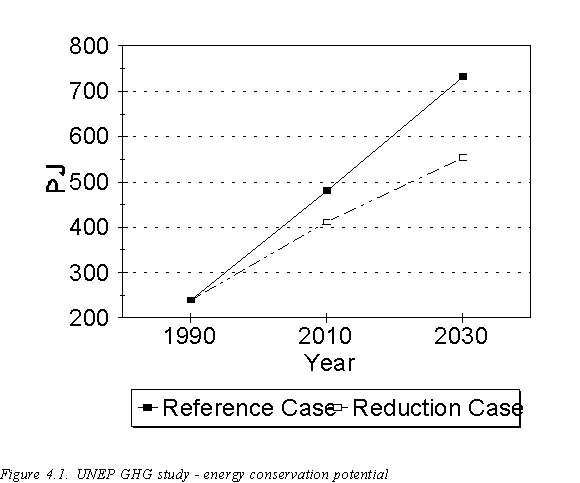
The above graph shows potential savings of 69.6 PJ in 2010 and 178 PJ in 2030,
representing respectively, 15% and 24% of total demand. These are significant amounts of
savings for industry and they should generate sufficient interest from government and
industry especially when it is considered that the conservation options will benefit the
economy as well. The following is a description of some of the options for energy savings.
The option of using coke oven gas for Hwange power station has been accepted and is
being implemented by the Wankie Colliery Company and ZESA to reduce the consumption of
Diesel fuel. The option is being implemented not as an environmental protection measure
but as a cost cutting measure for the WCC, ZESA and the government.
Zimbabwean industries rely on the locally produced boilers for process steam raising.
The boilers are made under license and 70% of the market is supplied by a single
manufacturer. The manufacturer designs boilers to an efficiency of 74%. This level of
performance can be achieved through correct operation of the boiler including fuel
quality, water quality, fuel air mixture and boiler maintenance. In some companies the
following areas where improvements can be achieved have been identified:
steam blowers are not used regularly,
the air/fuel mixture is not monitored,
water treatment is not employed,
fuel quality fluctuates and boiler controls are not checked frequently.
The resultant efficiency of the boilers was therefore estimated at 50% on the average.
The study assumed that the boilers could be redesigned to an efficiency of 79% as opposed
to the current 74% and operation procedures could also be improved. No measures are
initiated for implementation of the option.
The Zimbabwean industry also relies on locally produced electric motors. Before the
recent liberalization of the economy, foreign exchange controls and the closed economy
allowed the manufacturer to concentrate in meeting the demand without improvements in
motor quality. In fact limitations in foreign exchange availability encouraged the use of
low quality laminations and windings. The motors are generally very bulky in proportion to
the horsepower ratings, and the manufacturer also does not have a test facility for
efficiency measurements. The study assumed that industrial motor efficiencies could be
improved by 15% on the average by redesigning the motors. However, high efficiency motors
are not available in Zimbabwe or Southern Africa.
The SADC Industrial Energy Conservation Pilot Project was implemented under CIDA
funding by a Canadian consultant with three SADC counterpart staff. The project was
carried out in four SADC countries namely Zambia, Zimbabwe, Botswana and Malawi. The
project tasks included training in energy auditing, building awareness, and assessment of
the energy conservation potential in the region. The key criteria for selection of
companies was that they had to be small to medium manufacturing plants. This gives an
indication of the capacity to invest and the availability of technical expertise to
implement energy efficiency projects.
The project was implemented through surveys of industry which were fully funded by
CIDA. The surveys analyzed energy use in general and produced some estimates of energy
conservation potentials in industry. The conservation options were categorised as no-cost,
low cost and medium cost and high cost. No cost measures included improved house keeping
and equipment repair. Even though repair and maintenance cost money it was assumed that
these measures are included in the normal operation and maintenance costs of the plant and
should be implemented anyway. Low cost and medium cost measures included retrofits such as
boiler efficiency improvement equipment or instrumentation, condensate reclamation, steam
pipe insulation and coordination of steam usage. The investment in low cost measures would
mostly cover labour costs.
High cost measures included the installation of new plant and equipment which would add
to the value of the plant such as heat exchangers, pumps, light fittings and process
equipment.
The SADC project did not classify the options as negative cost or positive cost.
However the criteria of simple payback (SPB) gives an indication that an investment will
payback within its lifetime. The options had their simple payback calculated to indicate
financial viability. Table 4.2 below shows the results of the SADC studies and the
potentials for conservation in energy and financial terms. The options include reduction
of thermal losses, process efficiency and lighting retrofits. Apart from establishing
potential conservation options the project compared energy intensity in industry to best
industry practice in other countries.
Table 4.2. Conservation options identified by the SADC Pilot Project
| Typical energy conservation measure | Frequency | Savings | Cost saved | Installation | SPB |
| GJ/Yr | US$/Yrljr | US$ | Yr | ||
| Improved combustion efficiency Repair steam traps Switch off lights Repair steam leaks De-energize transformer Repair compressed air leaks Refrigeration improvements Demand control Fuel conversion Power factor correction Reclaim condensate Insulate boilers/kilns/furnaces Flash steam recovery Insulate steam piping Process/operations revision Insulate process piping/equipment Air curtains Waste heat recovery Insulated condensate piping Indoor lighting retrofit Outdoor lighting retrofit |
9 16 42 18 1 6 1 1 6 14 17 18 6 24 29 25 6 14 12 9 17 |
234770 142784 15411 133667 3784 1881 1287 0 0 0 78491 36017 25329 140321 154922 6915 4158 266667 24771 4799 4984 |
252831 134826 132029 126840 20661 11525 6369 3455 150186 265602 94402 39961 24798 117906 239921 14677 10020 832968 18139 27056 38425 |
62245 172531 62760 28608 17959 102479 212671 16723 12061 1141166 33782 59544 98744 |
0.4 0.6 0.7 0.7 0.7 0.9 0.9 1.1 1.2 1.4 1.9 2.2 2.6 |
| Total | 291 | 1280958 | 2562597 | 2021273 | 0.8 |
The Zimbabwe Energy Efficiency Project was commissioned by government (Ministry of
Transport and Energy) to address the issues of energy efficiency in the economy. The first
phase of the project was meant to identify potential options for conservation that can
lead to viable investments in energy conservation. The project was being done with a
background of rising electricity tariffs and shortage of electrical energy capacity in the
system. The project was funded through the International Energy Initiative (IEI) by the
Rockefeller Foundation. The project is meant to continue beyond 1996 when various physical
projects may be implemented as part of the National Development Programme. The major
players identified for the project were the utility (ZESA), the Department of Energy in
the Ministry of Transport and Energy and private consultants. Utility participation has
been limited to the review of reports and sporadic participation at some of the project
meetings. It has not yet been established why the utility participation is so limited.
Perceived benefits from the project are generally agreed to be reduction in expenditure on
investments for energy and reduced utilisation of fuels. The environmental benefits are
recognised but the advantages in redirecting the saved funds to other development
activities is a priority for government.
The Zimbabwe Energy Efficiency Project identified some options for energy conservation
in industry. The project tasks 5 to 8 addressed the issues of device efficiency in the
domestic sector. The tasks analyzed the potential for improvement in electric water
heaters, refrigerators, lighting and electric motors in industry. Electric motor
efficiency was aimed at identifying the potential for utilisation of high efficiency
motors. The study could not find a source for high efficiency motors in the region.
Instead a source for high power factor motors was identified. Electric motors were
estimated to use about 53% of the electrical energy used by industry. This figure was
based on information from the utility. It would however appear that electric motors are
the major industrial load and could be accounting for more that 80% of electrical energy
use in industry. This is because of the low coal prices which allow for high competition
from coal for heating in industry. The few cases where electricity arc furnaces are used
would not be useful in generalising industrial loads. The only fertiliser plant in country
produces ammonium nitrate through electrolysis. The plant is a major consumer of
electrical energy and the figures tend to distort the distribution of energy use in
industry by device.
A review of one of the factory reports indicated significant potential savings, yet
these options had not been implemented even one year after the study. The options had
simple payback periods of about one year for lighting retrofits and about 15 years for
other plant. Of these measures the following were recommended.
Table 4.3. Conservation options at bottling plant
| Measure | kWh Saved | kW Saved | Tonnes Steam | $ Saved | Cost | SPB |
| VSD Boiler fans Laundry Elec Lighting Power Factor |
144300 97500 79100 - |
16 30 9 - |
- -20 - |
27400 29750 15500 156500 |
260000 167000 122600 200000 |
9.5 5.6 7.9 1.3 |
Power factor correction had the shortest payback period. Zimbabwean industry has been
implementing power factor correction because the utility monitors reactive power demand
and correcting power factor allows for increase in factory capacity without additional
capacity from the utility. The immediate cost for power factor correction then compares
very well with the connection fees charged by the utility.
As opposed to the UNEP studies which considered costs to the economy the ZEEP studies
looked at the investment from the point of view of the customer. The difference is that
taxes and duties were included in the ZEEP studies. Also the perception of a viable
project differs between government and the private sector. The two approaches are however
useful in determining the criteria for investment in conservation by individuals and by
government.
There is a significant potential for energy conservation in industry. Given the
analysis carried out in the studies the economic and financial benefits of these options
are easily demonstrable. Government commissioned most of these studies thereby indicating
the policy makers' support for energy conservation. The department of energy itself is
central to the ZEEP project and assigned a member of its staff on a full time basis to the
UNEP supported greenhouse gas studies. The industrialists participated in the projects and
were recipients of the factory audit reports. During the UNEP studies the industrialists
responded to detailed questionnaires on production processes energy intensity of
production and projected energy demand. Information was therefore flowing between the
project team, industry, and government.
With the above scenario, it is clear that all the stakeholders are aware of the
available efficiency optimization options and only physical project implementation is
lacking. Industrialists who have refurbished their factories have done so to meet needs
for quality, volume and the expected competition from foreign suppliers. Energy efficiency
has seldom been given as a reason for investment. There is therefore a need to address the
efficiency options in industry as tools to implementation of environment protection in
Zimbabwe.
In addressing the options it is important to realise that efficiency is relative to
available options. The reduction of energy use by housekeeping, refurbishment, plant
replacement or management has to be designed to suit the environment within which the
options are to be implemented. There is no absolute value for efficiency. An example is
the use of high efficiency motors as based on international standards. The ZEEP project
had difficulty in identifying the source of high efficiency motors for Zimbabwe but
imported standard efficiency motors offer better performance than some locally made
motors. The definition of efficiency improvement used in this study is therefore
"improvement of performance to a level better than current." This allows for a
variety of options covering all ranges of capital investment. This report includes all
these options since the SADC studies considered no-cost, low cost, medium cost and high
cost options and the UNEP studies considered large investment options in both energy and
process efficiency. The following analysis will try and identify the barriers for all
levels of investment whilst indicating those specific to each cost category.
The Zimbabwean industry has experienced a history of economic sanctions and a closed
economy. The history was due to the political environment before 1980 when the then
government was not recognised by the international community. Economic sanctions were
imposed to force change in the political system.
The trade barriers however forced industry to strive for self sufficiency and to accept
outdated technology in their factories. A survey of industry showed that a lot of
equipment in the steel, textile and pulp and paper industry dates back to the 1920's.
After 1980 the economic sanctions were lifted in recognition of the new government. The
task was now to improve facilities for the underprivileged and achieve some economic
equity for the groups that were victims of the 25 year UDI period. The government
therefore took a path of controlling foreign exchange, prices, wages and trade in major
food grains. Industry could therefore not exercise its own criteria in investment, and
competition was poor. The following barriers appear as the main causes of the
non-implementation of energy conservation and environmental protection options even though
there maybe apparent financial gains for the industrialist.
A survey was carried out as a way of confirming the barriers to implementation of
negative cost environment protection options. The survey used energy efficiency studies
that have been carried out recently as a reference. The interviewees were industrialists
and individuals with relevant industrial experience. The questionnaire was basically a
list of the perceived barriers from the point of view of the Southern Centre and others.
The interviewees were asked to confirm the barriers and comment on their effectiveness.
Government Officials were also interviewed to obtain their view on the sentiments
expressed by industrialists. The following is a discussion of the comments made and
information received during the interviews.
The analysis carried out during the studies described in Section 5 indicated potential
gains in energy conservation. The gains were both economic and financial thereby making
the projects suitable for government and the private sector. Prices of energy however do
not provide enough motivation to initiate new investment for the purpose of saving energy.
An analysis carried out by ZESA showed that the cost of energy constitutes about 15% to
25% of the operating costs of the companies. This figure sounds very high but if it is
considered that most of the energy intensive industry has a very high value added the cost
of energy will be found to be small in comparison to the value of production. The argument
is also valid for coal. On the other hand it may not be reliably accurate to assume data
from ZESA to represent the true picture of the weight of energy as an input cost. With due
respect for commitment by industry to conservation there can still be identified cases
where the information provided to ZESA was inflated to present a favourable position in
tariff design and implementation. It is preferred to refer to independent surveys such as
the one by Southern Centre to verify the data. This difficulty with surveys was
highlighted in discussions with the Director for Energy.
Large industrialists also indicated that minor users of energy, such as the factories
with electricity as a minor cost do not have high regard for energy conservation since
energy costs do not have a notable influence on their profits. The response from the less
energy intensive industries is that they use very little energy and conservation would not
have an impact on their processes. The energy intensive industries however indicated an
awareness of the need for conservation as the market becomes competitive. An aluminium
extrusion plant indicated electricity as a major cost which resulted in a reaction from
the accountants who saw the need to conserve. The response from the accountants as opposed
to the process engineers indicates that the tariffs are becoming felt and may be high
enough to promote conservation. This is clear evidence that prices are now high enough to
encourage conservation but whether they are high enough to meet the economic cost of
production is a subject for further study. The initiatives by ZESA and The Ministry of
Transport and Energy to move towards Long Run Marginal costing will account for the
pricing of energy at economic costs.
The poor response from low energy intensity industry requires analysis once the energy
prices are based on LRMC. However opportunities exist with major energy users and as the
word spreads on conservation the small industries may also be captured in the new conservation
culture.
Electricity prices have been designed to protect the low income consumers and the large
consumers with true tariffs applied for the other tariff categories. The rationale to
protect the large consumers was an apparent misconception that the large industry would
fail if energy prices were high. The political environment at the time warranted
protection of the major industry in a bid to retain economic activity. The environment has
since changed with new government policy to promote competition. Recent efforts by the
utility have been to redress the anomalous situation where the large consumers enjoyed
negotiated tariffs which in most cases did not meet the cost of supply. In one case the
tariff had to be increased by 55% to align it with the other consumers. These measures are
bound to encourage conservation. A recent study by ZESA [Load Analysis Report] indicates
that electricity metering does not include reactive power in all major installations
therefore some consumers do not pay for poor power factor. The recommendation in the
report is that the utility meters all major consumers with kVA meters. Nevertheless time
of use tariffs need to account for the increases in production costs as the manufacturer
reschedules production to benefit from lower tariffs. In discussion with some
industrialists the current tariffs do not yield sufficient benefit to cover the cost of
overtime labour if the production times were to be changed. It has been possible in some
cases to reschedule automatic or unmanned machines to achieve savings of over Z$40 000-00
(US$5 000-00) per month as demonstrated by an aluminium processing plant. Energy pricing
can therefore not be taken in isolation to the other inputs to the production process. If
the tariff was to encourage time of use changes then the options would be to either
increase the upper band or lower the lower band. If the off peak energy was made less
expensive then there would be poor conservation during that time and the shift in
production times would result in loss of revenue for the utility. If on-peak tariffs were
increased then the rescheduling of production plant might create a new peak period. The
increased prices may also have an impact on the industries without flexibility to
reschedule such as the large metal smelters who work continuously. The utility would not
benefit from prohibitive tariffs as industrialists would seek alternative sources of
energy which may include resiting of new plants to countries with lower energy costs.
Caution should therefore be exercised in changing the price differential between off peak
and on-peak electricity prices.
The other major limitation on electricity pricing is that the load drawn during peak
periods is estimated. ZESA does not have time of use metering for all consumers so much
that in some cases the consumer does not see the need to shift load if the charge for load
coincident with the system peak is calculated as 35% of the total consumption. If time of
use metering was available then tariffs could penalise those contributing to the peak
demand thereby allowing the utility to avoid use of inefficient peaking plant. ZESA is
currently studying the potential of time of use metering. The advantage of fixed
proportion calculation of on-peak energy demand is that it encourages reduction of total
energy demand as the industrialist aims at reducing the total energy use. However the
tariff required to achieve this effect is not yet achieved and even when achieved the
consumer remains with limited options to reduce the energy demand.
Coal pricing is structured such that industry pays a very high transport charge. The
tariff therefore limits the use of coal by low income groups. The informal sector is
therefore forced to opt for firewood which in most cases is inefficient. An example is the
firing of bricks where wet logs are used with the resultant losses due to the wood having
to dry first before combustion. Fuel wood use has its other environmental impacts which in
developing countries are more serious than the impacts of coal and other fossil fuels.
This is because the loss of trees has an immediate effect on the quality of life. If coal
was affordable for these groups then pricing could afford some control over the energy use
in the informal sector as the sector would opt for commercial energy. Coal would yield a
better quality product and once popularised the switch back to fuel wood in response to
price would be limited.
Even though the coal prices are too high for the informal sector the large industry
with high value added does not recognise coal as a major cost. A survey by the Southern
Centre indicated that industrial boilers have an efficiency of less than 60% and it is
common to find boilers operating at 50%. Even though the efficiency improvement would
require mostly no cost measures, the cost of the coal does not yield enough motivation for
improvement of operation procedures. Large boiler operators tend to have better practices
probably due to the availability within the plant of highly qualified personnel.
Energy conservation technology is generally accessible to industry as it is available
in Europe, Asia and North America. The Purchase of production technology is however
dependant on the quality of product, volume of production and the capital cost of the
investment. Given the history of the Zimbabwean industry as described earlier the main
objective of the industry has been to provide a product without much regard for the
factors of quality and volume. The market has generally been small and volumes have been
generally low. The delivery system for efficient technology has therefore been limited.
During the ZEEP project electric motor manufacturers could not supply data on high
efficiency motors even though they supply a major portion of the international electric
motor market. The technology is available in Europe and North America but the marketing
system has not reached the region yet. One industrialist commented that the aim was not to
supply efficient motors but to meet the demand for motors.
Lighting has generally been available due to the promotion of efficient lighting in the
commercial sector. Lighting also has the added effect of visual impact which influences
the buyer in getting a product which looks different. In most applications compact
fluorescent lamps are not economically viable due to the limited running hours. A circular
fluorescent tube however looks "different". Commerce however has the added
interest to appear friendly to the environment and also to save money on the long burning
hours especially in hotels and public places. Industry has traditionally been reliant on
fluorescent tubes. Lighting is however not a major energy user in industry. The use of
fluorescent tubes is mostly due to higher light output and lamp life. Electronic ballasts
and high efficiency magnetic ballasts have not found high demand because of prices and
availability only from specialist shops. Lighting retrofits requiring change of lamp
fitting tend to be very expensive and in some cases would require rewiring of the
installation. In such cases as replacement of 8 foot tubes with 6 foot tubes the job tends
to be uneconomical for the investor. High efficiency 8 ft tubes are generally not
available in the region. The distribution of ordinary 8 ft tubes is also being phased out.
Industrialists interviewed so far indicate that technology is fairly accessible but
there is a limitation on the capacity to assess and analyze the options within the
country. The financial analysis or economic analysis is required for decision making
within the sector. The professionals who could possibly provide the service have been
indicated as failing to market their businesses to encourage requests for services. This
comment was made by a few industrialists and it was interesting to note that the
industrialists already have faith in local professionals but required them to make a
business approach for energy conservation. In one of the cases a local consultant had
been asked to make a proposal which was not convincing and the industrialist confirmed
that he did not sign the contract for presentation reasons. The alternative to local
consultants is imported professional services. Foreign consultants tend to make short
visits and are very expensive. Industry would prefer regular support for continuous
conservation activity.
Processes can now be monitored by control devices which optimise production time and
energy use. Such technology is marketed by large manufacturers who are well represented in
the region. The application of the technology is limited to modern equipment where the
necessary hook-ups can be made. An example is the electronic control of the paper
manufacturing process. Moisture control reduces energy demand significantly. However there
has to be provision for the installation of sensors and the control of the rollers should
be capable of automation. In some cases the factory would need rearrangement to achieve
efficient use of energy.
During a preliminary audit at a factory it was found that the boiler was not
sufficiently lagged. The reason given was that the parent company did not accept asbestos
as an insulating material and specified calcium silicate instead. Due to the availability
of asbestos in Zimbabwe suppliers of insulating material do not handle calcium silicate.
This is an example where foreign standards are imposed on a local company when the
technology is not available.
There are very few energy efficiency related consultancy organizations in Zimbabwe. A
recent call by the Environment Forum of Zimbabwe for companies to offer their services in
cleaner production found only 20 qualifying respondents. Efforts of UNIDO's Cleaner
Production Centre to enlist companies which promote industrial energy efficiency met
limited success as potential participants in the programme are traditional engineering
consultants. Thus, at present, only a few consultants are available to support energy
efficiency programmes in Zimbabwe.
Awareness of the benefits of energy conservation is quite high amongst industrialists
in Zimbabwe. The recent difficulties with electrical energy supply helped in raising
awareness especially in the conservation of electrical energy. The Confederation of
Zimbabwe Industries is a major player in the environmental protection arena in Zimbabwe.
The CZI has an Environment Committee which is active in environment protection and cleaner
production practices. An indicator of high awareness is the publication of a mission
statement by the CZI which includes environment protection and the inclusion of
environment protection statements in the annual reports of various major industrialists.
The awareness is however not adequately supported by knowledge of the basic technology
options for improvement of energy optimisation. If it is accepted that energy efficiency
is only relative to the existing situation with any option to reduce energy use being
accepted as an efficiency option then energy efficiency does not necessarily have to await
major investment. The value of no cost and low cost measures is not well realised. Given
the provision of a free service in energy audits by SADC and the presentation of
documented options for conservation of energy one could only assume that the value of the
report is not understood if the options are still outstanding two years after the study. A
supporting factor to this assertion is that Zimbabwe as a young economy has a large
proportion of small enterprises where the operator is least concerned about energy
conservation. The technical capacity to analyze energy use and evaluate the financial
benefits is often missing in such organisations.
At a national level the government has been implementing several projects to assess
options for energy conservation. The technical support has often been from abroad even
though the country has a large component of consulting engineers and scientists. In most
of these projects training was included which on closer analysis only means awareness
building. The success of the efforts has been limited by the lack of sustenance in the
effort and the absence of practical demonstration projects aimed at showing examples of
successes with energy conservation. The government is implementing a project termed the
Zimbabwe Energy Efficiency Project (ZEEP) which is expected to lead into demonstration
projects after 1996. The project has had difficulties in achieving the initial tasks of
deriving baseline assessment tools. The reasons are not clear but it is apparent that the
language of the project (economic analysis and assessment of benefits) is not clearly
understood. The methodology has sometimes not been clear and results of analysis have been
slow in coming. If the project was driven by the quest for well understood benefits then
its success would have been better.
Similar to technical capacity, awareness is most lacking in small enterprises. Large
companies normally have a network of trade partners and equipment suppliers who raise
awareness in opportunities for conservation. As the economy opens up under current reforms
there is bound to be an increased interest in cost cutting measures to enable local
industry to compete on the international market. This refinement of costs and prices will
need thorough knowledge of the cost of production and technological options. Discussions
with one industrialist indicated that local industry (large or small) is not knowledgeable
of the cost structure of their production processes. Even though cost centres may be known
the itemised input costs for each product are not known and therefore it is difficult for
industry to determine the possible changes that need to be made to reduce production
costs. Mere knowledge of the cost structure would prompt attention for the major items
since in most cases the change would be rearrangement of plant or change in production
timing or such other measure as may not require major investment.
The Zimbabwean economy has not been very competitive in the past. The economy was
virtually closed due to exchange controls and import restrictions. The local industry has
been limited in capacity and ability. In general the environment did not encourage new
industry. The result was a market that is not capable of discriminating against poor
products and product pricing. When this question was posed to industry there were varied
responses which were highly dependent on the size of the factory. Export directed industry
has always had competition from external manufacturers. There has therefore been limited
failure in their market.
In developed countries the promotion of energy efficiency leads onto a demand by the
market for the efficient devices. Once the demand exists the suppliers tend to produce and
distribute the devices.
The market in Zimbabwe suffered from the years of a closed economy and the buyer is
beginning to learn the need to specify and select the best value for money when procuring
goods and services. The supplier on the other hand is beginning to learn the skills of
trading in a competitive market. The economy is not completely open because there are
still some controls on foreign exchange. Competition between suppliers is therefore not
yet effective.
The major factor in Zimbabwe is a captive market for a few major manufacturers who
literally determine terms and trends in product evolution. An example is the production of
electric motors where other manufacturers have stopped production thereby allowing the
single manufacturer to control the market for electric motors under 180 kW. The electric
motor market is dominated by four major companies. The local manufacturer uses a
specification supplied by one of the manufacturers who has a joint factory in South Africa
with the third manufacturer. The fourth supplier operates from a European factory. It is
therefore apparent that the electric motor trade is dominated by two large players. The
competition is therefore limited.
Apart from devices, the supply of energy resources is also dominated by the three major
suppliers of electricity, coal and liquid fuels. These forms of energy are virtually
independent with very little potential for energy switching. Market forces are therefore
absent when it comes to the energy trade. Without competition the pricing, delivery
systems and management do not promote energy efficiency. An example is the stock piling of
coal fines which could be used as fuel for various economic activities and the pricing of
these as coal when the cost is recovered in the sale of the primary coal products.
Obviously the consumer opts for primary coal with the resultant environmental damage
associated with coal mining.
It is necessary that the market learns the benefits of energy conservation and demands
the efficient devices. Recently a supplier of refrigeration equipment included energy use
data in the advertisement for his equipment. It would seem logical that the competition
would advertise their energy consumption figures as well if lower. The response seems
lacking indicating that energy efficiency is not yet a selling point for device
manufacturers. There is also what may be termed a cultural overhead or closed
economy inertia amongst the potential customers for electrical or other energy
consuming devices. Due to the legacy of past economic controls, Zimbabweans are interested
mainly in price and the availability of spares or backup service for imported devices
which would offer improved energy use. The economic reforms now in place allow for easy
importation of spares and products and most devices such as refrigerators and water
heaters do have local maintenance support. The notion that the device will not be
repairable once broken arises from the days when import restrictions limited the goods
that could be brought into the country. Apparently this notion exists both with
manufacturers and consumers. Discussions with most local manufacturers indicated
unavailability of spares as a reason for not using imported items. For the manufacturer it
maybe a matter of maintaining the inertia as a way of maintaining the market.
Industrialists have been struggling to improve performance in the light of the
potential competition which will arise from the current economic reforms. During recent
industrial surveys, the Southern Centre established that a large number of factories have
either refurbished or replaced plant and more have plans to replace equipment. A textile
manufacturer had replaced the whole factory in a bid to improve quality and
competitiveness. All these measures are not directed at environment protection or energy
conservation but at reducing operating costs in general.
Given the efforts in plant replacement and the efforts by government to control
inflation by reducing capital availability it becomes apparent that there is a major
competition for capital and energy efficiency alone is not a strong contender. The SADC
study and the recent ZEEP studies presented reports which indicated options for energy
conservation with positive financial benefits. Some of the companies are expanding their
factories to include production of goods that were once imported and some of them are
expanding to meet increased demand. The conservation options therefore await their turn in
the queue for investment capital. The time might therefore be too early to assess the
response of private industry to conservation issues given the activities required for
immediate survival.
A major factor influencing investment in efficiency is the exchange rate fluctuations. The Zimbabwe dollar has been losing against major world currencies since 1980. The cost of imported technology has therefore been going up. Compounded by the shortage of foreign currencies the industrialist has had to make do with available equipment for survival. The following graph shows the exchange rate fluctuations since 1985.
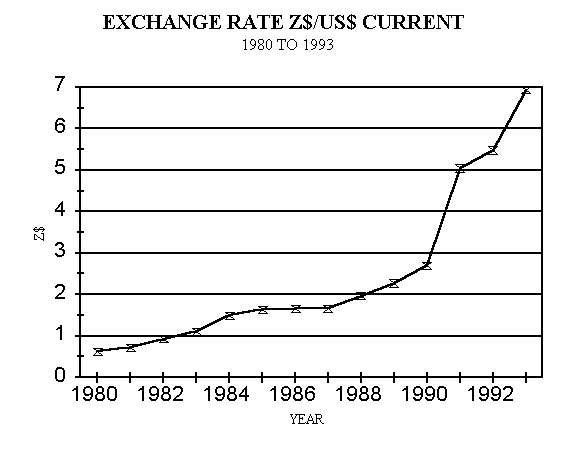 The graph shows major devaluations in
1991 and 1993. These were implemented as part of the economic reforms in a bid to draw the
currency closer to being convertible. Even though exchange control regulations have been
relaxed, the cost of hard currencies limits the demand such that supply remains sufficient
to meet the demand. During 1994 the exchange rate has been fairly stable at Z$8/US$.
The graph shows major devaluations in
1991 and 1993. These were implemented as part of the economic reforms in a bid to draw the
currency closer to being convertible. Even though exchange control regulations have been
relaxed, the cost of hard currencies limits the demand such that supply remains sufficient
to meet the demand. During 1994 the exchange rate has been fairly stable at Z$8/US$.
A recent study [GHG Abatement Costing Studies, Phase 3 - Southern Centre and Risų]
showed that about 40.3% of investment capital for projects approved in 1993 was in hard
currencies. Given the graph below in exchange rate fluctuations the capital requirement
would be increasing by about 25% per year through exchange losses. Given interest rates of
25% to 40% the cost of new investment was virtually impossible . Even though the exchange
rates have now stabilised the interest rates are still high and investors would not
consider efficiency as an option.
The survey of industry yielded a concern over availability of capital. The interest
rates are very high and investors are not keen on putting their resources into low
priority options. There have been limited comments on availability of capital with most
interviewees just indicating it as a barrier. The lack of comments may be due to industry
having accepted high interest rates as a given in the economy and investors having to live
with it. One industrialist even said that capital could always be borrowed. If one
considers the value added for each production process the limitation on capital may be
found to be linked to the possible rate of return in each industry.
5.9 Lack of financial incentives to equipment manufacturers
Discussions with one industrialist who manufactures solar energy devices indicated that
efficient devices or any other conservation devices attract duties and taxes unlike
equipment for the utility which can get exemption from duty. Import tax on imported goods
constitutes of customs duty, surtax and sales tax for goods sold in the retail market. The
government has the provision for declaring those investments that are of a national
interest where taxes and duties would increase the initial cost of the investment tax
free. An example would be the purchase of a power plant by the utility. If such status was
granted to materials for production of solar water heaters or efficient devices to the
extent that they reduce the potential expenditure in energy production devices then energy
efficiency would offer better competition to the supply market. This argument applies to
all energy supply systems including coal and liquid fuels. Recent changes in the taxation
system allows for duty free imports of capital goods. This does not apply to operation and
maintenance supplies. Also goods manufactured locally do not necessarily qualify for
reduction of duty on the components for the production process. The result has been poor
performance for local suppliers when it comes to supply of capital equipment. It is
therefore clear that the taxation system needs to be reviewed to avoid disadvantaging
local manufacturers when it comes to the supply of energy conservation technologies. It is
however true that duties and taxes have little impact on access to imported capital goods.
Environment protection encompasses all sectors of the economy. The environment
protection legislation in Zimbabwe is therefore fragmented with the hope that duties can
be shared as well. The difficulty is that the implementation of the legislation is not
coordinated with the result that some agencies actually contradict each other. The Mining
Act has often been quoted as contradictory to the other environment protection
legislation. At the National Response Conference to the Rio Earth Summit it was
acknowledged that legislation needed to be coordinated so that it becomes complementary.
It was also cited that complementary legislation will improve optimisation of resource
use. Since environmental protection is multisectoral the implementation of protection
legislation is of necessity by various agencies. An example is energy conservation being a
responsibility of the Ministry of Transport and Energy through the Department of Energy
which in turn is responsible for the liquid fuels supplying agencies, coal supply,
electricity and renewable energy. The protection of water and air are under the Ministry
of Health and Child Welfare because of the envisaged need of preventing pollution related
health problems. The interaction of the two government ministries needs coordination as it
relates to supply of energy for economic development and prevention of pollution. The
table below shows some of the legislative responsibilities in environmental protection in
Zimbabwe.
Industrialists who have been interviewed so far indicated that the legislation was
ineffective or absent. It was mentioned in one case that the regulations on emission
controls could be effective if enforced but the local authority responsible to enforce the
regulations never got to use the enforcement measures available to it. There is provision
for stopping production or imposing fines if emission levels were high. The industrialist
said that all he ever got were warnings. The legislation needs updating but implementation
has to be improved.
Table 5.1. Current environmental protection legislation in Zimbabwe
| Responsibility | Institution | Legislation |
| Forests and Wildlife | Ministry of Environment and Tourism | Natural Resources Act Forest Act Parks and Wild Life Act Bees Act Trapping of Animals Control Act Noxious weeds Act Plant, pests and dieses Act Communal land forest produce Act |
| Emissions | Ministry of Health Ministry of Local Government - Urban Councils |
Atmospheric pollution prevention Act Hazardous substances and articles Act |
| Mines | Ministry of Mines | Mines and Minerals Act |
| Water Pollution | Ministry of Agriculture and Water Resources | Water Act |
| Physical Planning | Ministry of Local Government | Regional Town and Country Planning Act Urban Councils Act District Councils Act Communal lands Act |
| National Monuments | National museums and monuments Act |
Source: Ministry of Environment
A global perspective on barriers to the implementation of energy efficiency options in
developing countries is given in Annex VII of this report. Annex VIII gives further
analysis of the case for Zimbabwe.
Analysis of barriers to implementation of energy conservation measures in industry
sector bring to the fore the necessity of delineation and implementation of measures in
the area of information dissemination and imparting training, provision of financial and
economic incentives, and establishing appropriate institutional structure in Zimbabwe.
Overview of these measures is presented in Table 6.1.
Table 6.1. Overview of implementation measures for energy conservation
| Area of impact | Implementation measure | ||
| Information and training | Financial and economic | Institutional and legal | |
| Operational performance | Plant audits Energy management courses |
Consultancy grants or subsidies | Energy management centres Engineering Consultancy Network |
| Investment in energy conservation and end-use equipment | Product information Specialized courses National databases |
Investment subsidies Tariff exemptions Market pricing of energy |
Performance standards DSM oriented utilities Demonstration projects |
| Process selection | System cost analysis Technology ranking |
Internalization of environmental management costs | EIA of technologies |
Improvements in the efficiency of energy use are probably the most important single
means to tackle the growing problems of air pollution and greenhouse gas emissions. Given
the dominance of coal in energy use, achievement of energy efficiency gains involving
macroeconomic structural change, industrial modernization, and specific technical
improvements take on added urgency as key components of the country's environmental
management strategy.
The policy options to promote electricity end-use efficiency include:
Setting-up National Energy Efficiency Centre (NEEC) to promote electricity end-use
conservation
Strengthening energy conservation initiatives
Adoption of appropriate energy conservation laws and regulations
Bridging the gap between private investment and public benefits through alternative
financial arrangements
Promote transfer of energy efficient technology and its use in Zimbabwe
The Integrated Energy Resource Planning (IERP) process which has great relevance to
Zimbabwe cannot be practised through the medium of ZESA. Innovative Demand Side Management
(DSM) options other than conventional load management strategies require utilities to work
closely with energy consumers. Unless inter-related institutional, regulatory, and
financial reforms are implemented to improve power sector performance in Zimbabwe, any
move to DSM practice is unlikely to meet with success.
A survey of non-U.S. industrialized countries shows that to promote energy efficiency
improvements most governments deemed it necessary to develop a National Energy
Conservation Program and to create and fund Energy Efficiency Centers.
The experience of these countries and a few developing countries indicate that
institutional arrangements should be tailored to meet the country's own specific needs. A
pre-requisite to the success of such a Centre is:
Commitment to energy conservation from the highest political level
An energy pricing structure that ensures the correct energy efficiency signals are
being sent to the user.
An unambiguous system for determination of policy and implementation
The provision of a National Energy Program having clearly stated objectives
The scope of the centre would comprise:
# Information dissemination and technical assistance
develop a National Energy Database by collecting and analyzing data on energy supply,
demand and information on prices
identify barriers to improving energy efficiency and propose appropriate incentives and
other measures to overcome them. These would include recommendations for assistance with
capital investment, taxes, duties and other financial incentives
review laws and regulations that have an impact on energy consumption and propose
modifications and formulate suitable policies and actions
suggest introduction of standards and labels and setting of consumption targets
provide planning assistance to government agencies
organise public information and promotional campaigns on an on-going basis
organise sector specific promotional campaigns for the main energy consuming sectors
(industry, transport, agriculture, commercial and government buildings). Also, provide
technical assistance in the field of energy efficiency to these sectors
promote or conduct energy audits in enterprises and provide recommendations to improve
energy efficiency and fuel substitution
monitor progress made in energy conservation and fuel substitution and initiate
follow-up actions where needed;
organise training for energy managers and equipment operators; and
implement multilateral and bilateral aided energy efficiency projects.
# Technology intermediation
Identify technology needs or opportunities in the country and put outside business
firms that use or offer up-to-date, efficient technologies in touch with companies that
need technology assistance
Provide an intermediation function for energy service companies
# Financial intermediation
Receive, appraise, and bundle labour intensive, low-capital- requirement, efficiency,
conservation, and alternative fuels projects for potential World Bank, commercial bank,
and other donor funding.
Government and utilities in industrialized countries have taken many initiatives to
encourage more efficient usage of electricity. In Zimbabwe SADC has conducted some energy
conservation activities for select industries. There is need to strengthen such energy
conservation initiatives, extend their coverage and improve coordination between the
various agencies involved. In general, these activities and programs are intended to
overcome the technical, economic, and institutional barriers.
The different actions that could be taken comprise:
# Information collection, collation and dissemination
Lack of information about potential savings, the cost of specific efficiency
improvements, and the availability of special energy management services or simply the
lack of adequately trained technicians are all barriers to improved electricity end-use
efficiency. They are also barriers to other forms of energy conservation and, as a result,
have long been the focus of considerable activity by both governments and energy
efficiency institutions.
The ultimate objective of energy conservation information programs is to assist users
in making choices about improving energy efficiency which are in their own economic
self-interest. Insufficient or unreliable information appears to be a major barrier to
improving end-use efficiency, especially in residences and smaller commercial and
industrial firms.
Providing general energy conservation information through brochures and advertisements
can raise public awareness, but may not have much impact on actual consumer behaviour.
Information and educational programs tend to be most effective when they provide consumers
with simple and specific steps to take along with estimates of how much energy and money
will be saved. General appeals to the public to save energy are usually less effective.
# Technical information dissemination and technology demonstration
A step beyond general information campaigns is the provision of technical information on specific measures to improve energy efficiency. Such information is usually most effective if it is based on the actual costs and savings experienced by users similar to the intended recipient.
Demonstrations are one way of obtaining such information on new technologies which have
not been applied previously.
Information could be disseminated through technical guides, training programs,
seminars, or demonstrations for particular industries, businesses, building types, or
end-use technologies.
# Energy audits and management services
Energy audits for residences, commercial buildings, and industrial facilities are very
useful for providing owners with information on what measures they can take to conserve
electricity and other forms of energy, along with the anticipated cost, savings, and
payback. This type of educational effort works best when accompanied by financing or
incentive programs in order to increase the likelihood that owners will follow up on the
audit recommendations.
Although energy audits are a vital first step towards improved efficiency, their
initial cost - as well as the difficulty of identifying and arranging for a skilled
auditor is often a significant barrier to conservation efforts. Governments could invest
in industrial energy audit studies as an alternative to power sector investments for
additional production capacity. Energy audits would assist in loss reduction which is
complementary to the current ESAP.
In addition to technical information about the benefits and costs of conservation
measures, most users ultimately require additional assistance to finance, install, operate
or maintain energy efficiency systems. Such services can be provided by private
businesses, such as banks, equipment suppliers, and engineering or construction firms. The
Government can through ZESA play a significant role in identifying, evaluating or
arranging for energy audit services. It would be best to implement such a strategy through
audit firms that ZESA could assist in setting up as ZESA would not need to create new
capacity where it already exists elsewhere in the economy. ZESA could then incorporate the
expected benefits as an element in the system development plan.
Energy policy-makers and those responsible for financing can encourage energy
efficiency programmes by making an energy audit a pre-condition for businesses and
industries to receive a loan. This is a stringent requirement which can cripple some small
industries. It can play a vital role in streamlining investment at larger plants
especially in the case of new investment. Most industry in Zimbabwe is battling with old
equipment and would certainly fail efficiency criteria for loans. It is not denied that a
mere requirement for an audit could be financed through the loan and could encourage
efficiency. Low efficiency could however not be used as a precondition for a loan.
# Education and training
The comparative newness of many of the techniques used to improve end-use efficiency
(and to evaluate possible efficiency measures) may result in a shortage of skilled
technicians - both in private companies which offer energy services, as well as in
companies that are major users of energy. To overcome such skills shortages, government
and ZESA can support education and training programmes ranging from specialized programmes
for engineering studies to short-term training workshops for industrial plant managers.
Because of the indirect effects of such efforts, it is virtually impossible to assess
their cost effectiveness, but they certainly contribute substantially to the ability of
energy users to obtain the technical services necessary for effective efficiency
programmes.
There is no doubt that training for energy conservation managers in private business
and industry is another potentially useful activity . Training is also needed for
professional energy auditors, inspectors enforcing efficiency regulations, and for those
providing technical assistance.
# Research, development and demonstration
The Research, Development and Demonstration (RD&D) of new, more energy-efficient
electric technologies or methods is another means by which end-use efficiency improvements
can be accelerated. There are many different areas that might benefit from additional
RD&D support including electric motors, compressors, new insulation materials, energy
storage, energy management systems, etc. While overseas private manufacturers and
suppliers conduct a wide range of research, this capacity is limited in Zimbabwe. Efforts
are usually restricted to product-oriented and fairly short-term quality control and
marketing activities. In addition, in Zimbabwe most of the manufacturers are so small that
they do not have the resources to support extensive R&D efforts. There is a limitation
on public research institutes which in Europe benefit the industry. Some support has been
provided in agriculture and related industry but this has been in terms of crop and animal
science. The Government of Zimbabwe is investing in a Scientific Industrial Research and
Development Centre (SIRDC), which is hoped to be able to grant the much needed support in
the energy, biotechnology, materials, electronics and computing science subsectors.
For these and other reasons, Government should sponsor RD&D activities directed at
improving electricity end-use efficiency. Areas for RD&D include heat pumps, lighting,
building controls, improved design and controls for motor drive systems, new magnetic
materials and superconductivity.
The creative approaches for promoting RD&D efforts could involve holding
competition asking manufacturers to submit bids for the most efficient
appliances/equipments assuring large orders from government/public sectors. The SIRDC
could conduct such a competition as part of its annual or biannual activities.
While many RD&D efforts will involve the organized sector, with the intention of
assisting with RD&D needed to produce equipment for the first time in the country,
similar efforts should also be undertaken to assist small-scale industries to improve the
efficiency of their equipment. It has been observed in many countries that the efficiency
of equipment in the small-scale sector often lags equipment efficiency in the organised
sector. By assisting small-scale producers to produce more efficient equipment, they will
be better able to compete with the organised sector over the long-term. Assistance can
include training programs, technical publications and software, and customized technical
assistance provided by industry experts.
Efficiency regulations can be used to avoid the uncertainties inherent in a
less-regulated market place. If a decision is taken to postpone augmenting power
generation capacity based on expected end-use efficiency improvements, then it is
desirable to ensure that these improvements are made in response to efficiency regulations
rather than hoping they will occur in response to price signals and/or financial
incentives.
Regulation should, wherever possible, employ economic incentives to achieve its goals.
Promoting end use efficiency among the large number of dispersed commercial building and
small-scale consumer groups through building codes and upstream standards for
manufacturing would be preferred approach for Zimbabwe. Such programs usually have a
relatively small investment component but require a large and sustained technical
assistance effort over the long term. For effective implementation of such regulations
laboratories will be required to measure standards; producers, consumers and governments
will have to agree on acceptable standards; and the institutional mechanisms will have to
be strong enough to support the enforcement of those standards. Both CZI and SAZ will have
to play an active role in development and implementation of standards.
The regulations/laws could cover:
Government support for RD & D activities, energy audit and training programs
Introduction and implementation of appliance efficiency labelling schemes
Incentives to electrical equipment manufacturers to increase the efficiency of their
products
Mandatory building codes
Restrictions on the use of air conditioners, elevators and outdoor lighting
Financial incentives, and tax incentives for industry
Subsidized loan programs for conservation investments
Higher building standards for the building fabric and heating equipment installations
Improving transport fuel economy and energy performance labelling of equipment
Accelerating the use of co-generation and in particular reducing environmental
pollution
Use of minimum life cycle cost as the basis for selecting electricity-consuming
equipment by the public sector
Standards prohibiting the sale of certain types of inefficient products
Currently, the capital costs of generation equipment are paid by ZESA and the capital
costs of enduse equipment are paid by the end-user. The high effective discount rate of
the enduser as well as the separation between utility and user (or for leased equipment,
the separation between owner and user) leads to much lower levels of investment in end-use
equipment efficiency than is justified on the basis of either total system capital costs
or life cycle operating costs. Alternative financial arrangements to redress this
"disconnect" might range from the enduser choosing equipment according to the
total life cycle cost and paying this cost in monthly instalments on the utility bill; to
the enduser paying a front-end deposit or posting a bond to the utility to cover the life
cycle operating costs of the equipment, against which the utility would charge the capital
cost of the equipment on the monthly electricity bills. Either of these approaches would
force the enduser to directly face the total systemwide life cycle costs of the equipment
when purchasing it.
Many of the efficiency options with the highest savings potential involve technologies
which are routinely employed in industrialized countries, but are not yet employed in
developing countries such as Zimbabwe. Examples of these include compact fluorescent
lamps, improved efficiency refrigerators, air conditioners, evaporative coolers and high
efficiency motors. Key components of a strategy to achieve technology transfer would be:
research, development and demonstration projects to adapt foreign technologies to suit
socio-economic and cultural environment
technical assistance, and selective financial assistance to manufacturers to encourage
them to produce products incorporating improved technologies
selective reductions in import duties, both on equipment needed to produce products
domestically, and on limited quantities of products to encourage adoption of the
technology and establish a market
Although the basic technologies remain the same, other factors - raw materials,
capital, labour, technical and managerial manpower, political, trade regimes etc. - vary
dramatically between industrialized countries and Zimbabwe. These cases range from
informal rural cottage industries to subsidiaries of multinationals that have access to
the best technologies available. This wide range of conditions and capabilities requires a
similarly wide range of policies in order to respond appropriately. Government
organizations and utilities are logical sponsors of R&D on more efficient products,
with the work carried out by a private company, university, research laboratory, or some
combination such as SIRDC.
Environment is viewed as a stand-alone sector in Zimbabwe and the responsibility for environmental management rests with authorities that have little or no control over destruction caused by environmentally unsound policies in various socio-economic sectors such as agriculture, industry etc.
An ideal way to minimize interpolicy conflicts is through a shift from population based
socio-economic planning process to regional carrying capacity based planning process. In
India, such studies are in progress under the auspices of the Ministry of Environment and
Forests in four critical regions of the country. Such studies will ensure minimal
inter-policy conflicts in charting resource-based planning in Zimbabwe.
Given the complexities and an enormous variety of industrial processes and the variance
in local conditions, no single technology can be universally optimal in any sector. It
will always be necessary to view available technologies as a starting point and to possess
indigenous capability to critically review and adapt, if feasible, what is available.
There is thus a need to enhance basic capability in engineering in Zimbabwe, both for
assessing energy efficient production technologies and environmental protection
technologies.
Environmental impact assessment (EIA) of developmental activities is the accepted tool
for internalizing environmental concerns in the overall process of decision making.
Environmental impact assessment has sustainable development as its primary objective. It
is imperative that the emphasis should be not just on improving skills and methodologies
but also on the involvement of the public for whose good the development project is
conceived. The Ministry of Environment and Tourism introduced EIA Policy in July 1994 for
project level, voluntary, EIA.
It is now necessary that steps are taken to ensure the following:
Development of an adequate organisational structure to internalise environmental
concerns in project planning.
The creation of adequate multi-disciplinary professional groups in the Ministry of
Environment to make objective assessment.
The creation of multi-disciplinary professional groups to integrate the preparation of
impact assessment and Environmental Management Plans as integral component of the
development project.
Formulation of guidelines for the licensing agencies to assess the capability of
prospective entrepreneurs to undertake major operations in a systematic and scientific
manner.
The creation of a viable Monitoring Network to ensure that the Environmental Management
Plans are effectively implemented.
Development of skilled and professional managers.
The creation of a cadre of professional Environmental Managers in the country for the
preparation and implementation of Environmental Management Plans.
The development of methodologies specific to the local situation and problems.
The development of norms for the quantification of the environmental costs and
benefits.
The development of professional groups and centres of excellence, dedicated to
environmental management problems, in the universities and institution of higher learning.
Introduction of a system of public hearings, at an appropriate time, at least in the
case of complex projects.
Creation of reliable baseline environmental data to facilitate impact assessment by
adopting basin approach.
Undertaking carrying capacity studies for
Ecologically sensitive areas
Areas with a concentration of industries and mining operations
Areas already critically degraded
Areas considered to be rich in mineral resource.
Zimbabwe will depend on industrialized countries for importing efficient coal
combustion technologies, retrofitting technologies for existing industrial units,
energy-efficient production technologies for new industries and technologies for biomass
derived fuels. Bilateral and multilateral agencies will have to play important roles in
technology transfer in terms which would be in favour of Zimbabwe.
Combustion technologies
Combustion technologies can be classified broadly into the following two categories:
Conventional coal combustion technologies
Advanced coal combustion technologies
The conventional technologies are based on grate firing and pulverized fuel combustion
systems while advanced coal-fired plants fall into the following five main categories:
Technologies employing fluidised bed combustion in conjunction with steam turbine
generators
Technologies employing fluidised bed combustion in conjunction with gas turbine
generators and waste heat boilers and steam turbines
Technologies based on coal gasification processes, that convert coal into gas which can
then be used as a fuel in a "conventional" combined cycle plant
Technologies based on a combination of above technologies, such as topping cycle
process
Integrated chemical and power plant
The overall thermal efficiencies of these advanced coal technologies are equal to or
better than the existing pulverized coal plants and could reduce emission of SOX, NOX and
particulates.
The use of clean coal technologies could be promoted through internalization of GHG
emission as a criterion in evaluating new to coal combustion units.
Energy efficiency improvements options
These involve use of efficient equipment and improved operating procedures and
production processes for reducing energy intensity, which is defined as energy use per
unit of production. The major options include:
Improvement of efficiency of electric motor drive systems
Better house-keeping
Retrofits of existing plants
Use of state-of-the-art processes in new plants
Use of low temperature waste heat for preheating
Use of high temperature waste heat for co-generation
The most common types of motor drive systems in industry include pumps, fans,
compressors, conveyers, machine tools, and various rollers, crushers, and other
direct-drive systems. Motor driven pumps, fans, and other system components are usually
deliberately designed to be oversized to have excess capacity. Many systems need variable
outputs. Space heating and cooling, manufacturing, municipal water pumping, and most other
motor drive loads vary with time of day, the season. Such variations can be very large.
Traditionally, throttling valves or vanes have been the principal means by which flow is
controlled. This is, however, an extremely inefficient means of limiting flow. The direct
and indirect energy losses due to such control strategies include part load operations,
poor power factor, throttling losses, excess duct or pipe friction, and pump or fan
operation off the design point. Industrial and commercial pumps, fans and compressors,
have average loss of 20-25 % due to throttling or other inefficient control strategies.
Technology options available to industry are use of variable speed drives and high
efficiency motors.
Most of the industrial energy use is in steel, cement, chemicals (especially fertilizers) and paper manufacturing units. Total energy used to produce these materials will increase rapidly in the near future. Hence it is desirable that the manufacturing process is carefully selected so as to avail benefits of the state-of- the-art technologies. This is illustrated through comparison of energy intensity of manufacturing processes in Zimbabwe and developed countries in Table 7.1.
Table 7.1. Energy intensity of industrial production in Zimbabwe
| Energy intensity in selected industries - Zimbabwe |
TOE/unit | Typical world intensity - Minimum |
Typical world intensity - Maximum |
| Textiles Leather Personal care products Brewery Edible oils Metal refinery Food canning Timber Tobacco processing |
1.833/tonne 0.088/tonne 0.073/tonne 0.009/HL 0.264/tonne 0.265/tonne 0.230/tonne 0.239/m3 0.163 /tonne |
0.552 0.011 0.007 0.003 0.108 0.085 0.058 0.069 0.051 |
0.8096 - 0.0138 0.0087 - - 0.1288 - - |
Source: SADCC industrial Energy Conservation Pilot Project, paper presented at Seminar
on Energy Conservation in Zimbabwe: Issues and Options, 10-11 September, 1990
Thermal electric production has a relatively low thermal efficiency in which
approximately two-thirds of the heat content of fuels is rejected to the environment.
Cogeneration facilities permit the utilization of as much as 80 percent of the heat
content of the fuels. In USA, many small scale co-generation facilities have been
developed in industrial sector. A variety of technologies are now available to improve the
overall efficiency of cogeneration such as replacement of conventional steam turbines with
recovery of a portion of the waste heat, with higher efficiency and less costly
gas-turbine cogeneration systems, and combined cycle systems that use some of the heat
from the gas turbine to run a lower temperature steam turbine as well as provide process
steam.
Fuel switching can lead to reduction in air pollutant emissions but implementation
depends on relative price. Switching fuels can be between different fuel types or between
fuels and electricity. The first option is to switch from high carbon fuels to fuels with
lower carbon content (e.g., coal to natural gas). Switching to electrical energy is
advantageous if the power is derived from sources such as hydro, solar, biomass, or
nuclear, which are themselves not net producers of harmful emissions.
The energy required to deliver industrial goods and services can often be lessened by
using existing material more effectively or by changing the types of materials used.
Significant amounts of energy can be saved by recycling steel, aluminium, glass, paper,
and other materials.
Even greater savings may be possible if, rather than melting down and recasting the material, the material can be used in exactly the same form as before - for example, if glass bottles are of standard size and shape and can simply be washed out and reused.
Table 7.2. Energy intensity of primary and recycled materials
| Material | Primary GJ/mt |
Recycled GJ/met |
Savings (percent) |
| Aluminium Glass Paper Newsprint Printing paper Tissue paper Solvents Steel |
242-277 17.8 51.6 78.8 79.7 27.9 18.1 |
9.9-18.7 12.3 40.4 50.5 34.3 4.7 7.6 |
92-96 31 22 36 57 83 58 |
Source: US Congress, Office of Technology Assessment, Facing American's Trash : What
Next For Municipal Solid Waste? OTA-424 (Washington, DC : US Government Printing Office),
October 1989; Energetics, Inc. Industry Profiles : Waste Utilization, US Department of
Energy, Office of Industrial Technologies, DE-ACO1-87CE40762, Dec. 1990
Major issues associated with the potential for achieving recycling are:
creation of markets for postconsumer-recycled material in the manufacturing of high
quality products
mechanism for reliable and clean collection of selected postconsumer and industrial
waste materials
regulatory changes to allow currently defined as "waste" streams to be used
as feedstocks, both within a single industry and between industries
Biomass offers an opportunity for reducing emissions because it has the potential to
supply process energy, feedstock for chemicals, and transportation fuels on a neutral
basis. The major technological options are:
development/demonstration of technologies for improved conversion of biomass,
especially for wood derived cellulose and hemicellulose, to ethanol and other products
development/demonstration of technologies for improved anaerobic digestion of farm and
municipal wastes to produce methane
selection of species for afforestation which provide high yields of dry biomass and
have low energy requirements during processing
There are some basic principles to be followed in technology transfer viz.
Technology to be transferred should be appropriate to conditions in the recipient
country. In some cases, this would mean that the latest and most advanced versions should
be provided; in others, simpler or more labour intensive versions would suit more
Licensor should be obliged and capable of providing the needed training to key
personnel in the recipient country
The licensed technology should utilise, as much as possible,local resources, including
raw materials, labour and supervisory personnel
The activity should make a real-time contribution to the economy of the recipient
country that is greater than mere import substitution
Various modes of technology transfer are licensing, contractual use of products and
processes by corporations in other countries, and transfer of technology to subsidiaries
and joint ventures. These mechanisms are more effective if the initial contracts provide
for maximum technical assistance and practical training implying heavy involvement of
foreign technical experts, managers and other specialists in the early stages of the
project.
International conventions also provide a useful means of encouraging the transfer of
technology. For example, Article 3 of the Convention on Long Range Transboundary Air
Pollution provides for the contracting parties to facilitate the exchange of technology to
reduce nitrogen oxide emissions by exchanging existing technology and information, and
promoting technical assistance and industrial co-operation.
Technology for products and processes can be transferred through the governmental
purchase of property rights, or perhaps compulsorily transferred where the technology was
developed with the public funds. Another unilateral measure that governments can take is
to reorganise the academic system in tune with the requirements of advanced agricultural,
industrial, energy, mining, health and human settlement sectors.
Technology is best transferred through a commercial transaction between enterprises,
which is of mutual benefit to both parties. Multinational companies could play a special
role in accelerating technology transfer, as they are the most effective channel for such
transfer, and for building a trained manpower pool and infrastructure.
It is recognized that the technology transfer from developed countries in manufacturing
sector will continue to take place in the foreseeable future. While CZI could facilitate
the transfer mechanisms that are in favour of Zimbabwe, equally, if not more, important is
to assess the true potential of natural resources, environmentally-sound conversion
mechanisms, and labour intensive devices to resolve poverty, unemployment and
environmental problems prevailing in Zimbabwe.
While the energy saving advantages of energy efficient technologies are usually
recognized, the common perception is that their widespread adoption will not occur because
of their high initial cost.
The experiences with government and utility financing suggest that conservation
financing is more likely to be successful if funds are made available at attractive terms
for the private sector. Of course, financing involving interest subsidies should be
subject to rigorous cost-effectiveness tests. Also, participation should be made as
convenient as possible, and it may be necessary to market loans to eligible businesses or
individuals. Finally, financing is best received if it is complemented by information,
technical assistance, energy prices that encourage conservation.
The government could provide economic incentives for the purchase of more efficient
products by lowering taxes on very efficient models. Likewise, sales taxes on less
efficient, high-powered products could be increased to maintain or increase government
revenue. Such taxes can be best justified in situations where inefficient products are
commonly used and are encouraged by energy price subsidies or other factors. Setting
import duties in a way that favours more efficient equipment is one way to encourage
electricity conservation.
The action plan can be carried in a series of activities which can be subdivided into a
number of categories as follows:
| Type of Action | Action | Lead Institution |
| I: Policy and planning |
I.1 Minimization of environmental impacts of energy related activities by Formulation of environmental management policy for coal mining Formulation of environmental management policy for thermal power plants Formulation of national energy conservation policy Capacity building for technology assessment Mandatory environmental and energy audits |
Ministries of Environment and Mining Ministry of Environment & Dept. of Energy Dept. of Energy MOE & DOE MOE & DOT |
| I.2 Strengthening energy conservation initiatives - Information collection, collation and dissemination - Developing database on technical information - Demonstration of energy efficient technologies - Energy audits of select industrial units - Education and training |
National Energy Effi-ciency Centre (NEEC) NEEC NEEC NEEC NEEC |
|
| I.3 Adoption of appropriate energy conservation laws and regulations to ensure - Government support for RD & D activities, energy audit and training programmes - Provision of incentives to equipment manufacturers to increase the efficiency of
their products - Institution of financial incentives, and tax incentives for industry |
DOE & NEEC DOE & Ministry of Finance DOE & Ministry of Finance |
|
| I.4 Bridge the gap between private investment and public benefits through alternative
financial arrangements - Institution of concessional financing schemes for energy conservation investments - Subsidies, rebates, leasing of energy efficient equipment |
MOF, DOE Zimbabwe Electricity Authority (ZESA), DOE |
|
| I.5 Promote transfer of energy efficient technology: - Research, development and demonstration projects to adapt foreign technologies - Providing technical assistance, and selective financial assistance to manufacturers
to encourage them to use efficient technologies - Reduction in import duties on energy efficient equipments |
NEEC & National Cleaner Technology Centre (NCTC) NEEC & NCTC DOE & MOF |
|
| II: Institutional development |
II.1 Setting up Environmental Monitoring Organization under administrative control of
Ministry of Environment and Tourism to - Prepare inventory of industries using coal directly and consequently releasing air
pollutants - Undertake environmental audit of thermal power plants to assess sources of pollution
and potential of minimizing environmental impact - Design and implement National Ambient Air Quality Monitoring Programme to establish
source-receptor linkages and update emission standards - Undertake periodic monitoring of industrial sources of air pollution to ensure
compliance with standards - Prepare State of the Environment reports |
MOE MOE & Ministry of Mining MOE & DOE MOE MOE & Confederation of Zimbabwe Industries (CZI) MOE |
| II.2 Setting up Environmental Impact Assessment Division in Ministry of Environment
and Tourism to - Appraise EIA studies - Provide support to other ministries and parastatals to integrate environmental
concerns in developmental planning - Monitor implementation of Environmental Management Plans proposed in EIA studies - Prepare manuals for environmental impact assessment considering specific local
situations and problems - Institutionalize public hearings to ensure participation of the public in decision
making - Conduct carrying capacity studies |
MOE | |
| II.3 Setting-up National Energy Efficiency Centre (NEEC) to promote energy
conservation for : - Information dissemination and technical assistance - Technology intermediation - Financial intermediation |
DOE, MOE & CZI | |
| III: Enhanced international cooperation |
Sourcing multilateral and bilateral funding and technical assistance in following
areas : * Education at professional levels in energy conservation * Building information systems and networks * Evaluating the environmental soundness of transferred or newly developed technologies
* Building up capabilities in technologies such as remote sensing, geographic
information systems, and pollution monitoring to assess existing environmental quality * Funding demonstration projects for energy efficient technologies * Establishing national and regional databases with user- friendly access systems on
technologies * Organizing national and international debates on technology selection * Building design capabilities in Zimbabwe through joint ventures * Internalizing need for human resources development and training in all phases of technology transfer |
MOF, MOE & DOE |
| Sr. No. | Technology | Salient Features | Drawbacks | Emissions |
| A. Conventional technologies | ||||
| 1. | Grate firing coal combustion | Early systems used flat grate with manual feeding and ash removal | Fractions of coal < 3 um cannot be utilized | Ash contains high carbon |
| Later systems use moving grate or spreader stoker | Uneven temperature distribution and fuel supply characteristics limit complete combustion through the furnace | NOx emissions relatively low (200-300 ppm) |
||
| Oxidant stream is blown through layer of coal on grate | Automation difficult to achieve | |||
| Rate of combustion is proportional to specific surface of coal particles | High thermal productivity difficult to achieve | |||
| 2. | Pulverized fuel combustion | In operation for more than 50 years | Requires coal grinding | Major portion of ash is carried away as particulates in flue gas (pulverized fuel ash or PFA) |
| Most large boilers employ this technique | Ash tend to fuse at temperatures encountered in furnace | NOx emissions high (500-700 ppm) | ||
| Pulverized coal < 200 um combusted in suspension | No SOx emission prevention | |||
| Insensitive to coal quality | ||||
| Furnace regulation relatively easy | ||||
| High degree of uniform fuel combustion at relatively high temperature | ||||
| B. Advanced coal combustion technologies | ||||
| 1. | Atmospheric fluidised bed combustion | Uses fluidised bed boilers with steam turbines | Maximum boiler size in operation 120 MW electrical | Low SOx and NOx emissions |
| Staged combustion | No reduction in CO2 emission | |||
| Boilers operate at low temperatures compared to pulverized fuel fired boilers. Hence less NOx emissions (225-400 mg/NM3) |
||||
| Limestone added into combustion process to control SO2 (> 90% removal) |
||||
| Efficiency same as conventional boiler | ||||
| 2. | Pressurized fluidised bed combustion | Allows use of gas turbines to utilize the high pressure combustion gases | Process being demonstrated commercially | NO2 emission 145-575 mg/Nm3 (50-200 mg/MJ) |
| Coal and limestone fed at the base of bubbling bed combustor | 90% sulphur removal | |||
| Coal burn at 800-900oC with 30-50% excess air and combustion efficiency more than 99% | ||||
| 3. | Integrated gasification combined cycle (IGCC) | Coal gasified in pressurized gasifier | 99% sulphur removal | |
| Gas cleaned to remove sulphur compounds, chlorides, ammonia, cyanide and solid particles | ||||
| Facilitates production of pure elemental sulphur | ||||
| Steam generated in cooling and gas turbine exhaust waste heat recovery boiler used in generating power | ||||
| Sr. No. | Process | Temperature oC |
Total NOx emissions as NO2 mg/MJ |
N2O emission mg/MJ |
| 1. | Pulverised fuel combustion (PFC) | 1300 |
280-358 |
1-10 |
| 2. | Atmospheric fluidized bed combustion (AFBC) | 900 |
126-270 |
18-50 |
| 3. | Circulating fluidized bed combustion (CFBC) | 850 |
90-203 |
27-48 |
| 4. | Pressurized circulating fluidized bed combined cycle (PCFB-CC) | 850 |
50-143 |
7-30 |
| 5. | Integrated gasification combined cycle (IGCC) | 1400 |
8-41 |
0-5 |
| 6. | Toppling cycle (TC) | 850 | 70 | 10 |
| Technology | Conversion Efficiency (percent) |
Emissions | ||
| NOx | SO2 | CO2 | ||
| (grams per kilowatt hour) | ||||
| High-sulfur coal-fired steam plant (without scrubbers) |
36 |
4.3 |
21.1 |
889 |
| High-sulfur coal-fired steam plant (with scrubbers) |
36 |
4.3 |
2.1 |
889 |
| Low-sulfur coal-fired fluidized bed plant | 32 | 0.3 | 1.2 | 975 |
| Oil-fired steam plant (uncontrolled) |
33 |
1.4 |
1.6 |
794 |
| Integrated gasification combined cycle plant (coal gasification) |
38 |
0.2 |
0.3 |
747 |
| Gas turbine combined cycle plant (current) |
43 |
0.3 |
0 |
416 |
| Gas turbine combined cycle plant (advanced) |
55 |
0.03 |
0 |
331 |
The figures in this table are for particular plants that are representative of ones in
operation or under development. These plants operate under the following conditions:
fuel is coal with 2.5 percent sulfur content,
turbines are steam-injected gas type,
they use intercooled chemically recuperated gas turbine with reheat to improve the
efficiency of converting exhaust steam into fuel energy.
Sources: Richard L. Ottinger et al., Environmental Costs of Electricity (New York :
Oceana Publications, 1990); Jennifer Lowry, Applied Energy Systems, Arlington, Va.,
private communication, September 18, 1991; Meridian Corporation, "Energy System
Emissions and Material Requirements", prepared for Deputy Assistant Secretary for
Renewable Energy, Department of Energy, Alexandria, Va., February 1989; Edwin Moore and
Enrique Crousillat, "Prospects for Gas-Fueled Combined Cycle Power Generation in the
Developing Countries," Energy Series paper No. 35, World Bank, Washington D.C., 1991;
California Energy Commission, Fuels Report 1989 (Sacramento, Calif.: 1989)
| Baghouses Filters | Electrostatic Precipitators |
| Constant size without affecting efficiency, assuming equipment is designed for worst conditions (maximum flow) | Constant efficiency devices thus size affects efficiency |
| Relatively constant emissions for any flow rate | Efficiency varies with flow rate |
| Pressure loss across the fabric filter will be approximately 1,500 pascals, not including ductwork. Requires higher fan power | ESP pressure losses are usually between 125-500 pascals, not including ductwork |
| Pressure loss is an exponential function of gas flow | Pressure loss varies slightly with changes in gas flow |
| Flow is divided among compartments to maintain system with variable flows through compartments | Even gas flow distribution is critical to obtain design efficiency. Requires distribution devices. |
| Emissions are more constants as the grain loading and particle size vary. Best choice for producing low opacity plume under all conditions | Particle size and grain loading will affect outlet emissions. Can produce zero capacity plume. |
| Percent sulfur and sheet resistivity do not affect fabric filter efficiency | Efficiency vary as percent sulfur and resistivity fluctuate. |
| Below 260oC (cold side), temperature fluctuations do not affect efficiency | Efficiency is sensitive to changes in gas temperature |
| Individual compartments can be isolated to allow on-line maintenance without curtailing boiler output | For on-line maintenance one entire ESP must be removed from service. If two trains are used, shutting down one train for maintenance reduces efficiency or requires operation at reduced load. |
| Requires flue gas temperature control for fabric protection at low loads and high temperature excursions. New fibre glass fabric is not subject to fire at high temperature | No practical upper temperature limit |
| Normal maintenance is comparable to ESP's. Bag replacement is a costly extra maintenance item. | Normal maintenance is comparable to baghouse |
| Fewer ash hoppers and no sneakage baffles in hoppers | More ash hoppers (more ash pick-up points). Hoppers have sneakage baffles. |
| Performing well in most coal-fired power plant applications since early 1970's. Being applied at an accelerating rate. Performance, maintenance, and operating costs still somewhat undetermined. | Many units operating well in large plants. Proved performance and costs. |
| Process Chemical used | Operating conditions | Sulphur removed | ||||
| Temp. oC |
Pressure bar |
Time min. |
Pyrite | Organic | ||
| PETC- oxidation |
Air, calcium carbonate | 150-200 | 55-69 | 60 | 95 | 13 |
| Ames-wet oxidation |
Oxygen, sodium carbonate | 150 | 20.7 | 60 | 80-90 | 20 |
| Lodgement- oxidation | Oxygen, calcium carbonate, ammonia | 200 | 20.7 | 60 | 80-90 | 20 |
| Arco-oxidation | Oxygen, calcium carbonate, promoter |
120 343 |
21.7 16.07 |
60 60 |
88-98 65-89 |
0 23-30 |
| TRW Mayers- oxidation |
Oxygen, ferric sulphate, acetone, calcium carbonate | 100-130 | 3-6.1 | 300-480 | 84-99 | 0 |
| JPL Chloinolsis- oxidation |
Chlorine, 1,1,1-trichloroethane | 60-130 | 1-5.2 | 4.5 | 71-95 | 46-98 |
| KVB-oxidation displacement |
Nitrogen dioxide, sodium hydroxide | 100 | 1 | 3-6 | 60-100 | 30-50 |
| Battle hydrothermal-displacement |
Sodium hydroxide, calcium hydroxide, calcium carbonate, carbon dioxide | 250-350 | 41-172 | 10-30 | 90-95 | 20-70 |
| TRW Gravimelt- displacement |
Potassium hydroxide, sodium hydroxide | 370 | 1 | 30 | 90 | 75 |
| General electric microwave displacement |
Sodium hydroxide | N/A | 1 | 0.5-1 | 90 | 50-70 |
| Magnex-magnetic suspectibility |
Iron pentacarbonyl | 170 | 1 | 30-120 | 57-92 | 0 |
| IGT hydro- desulphurisation |
Hydrogen, Iron oxide | 800 | 1 | 60 | 90% total sulphur | |
| Chemical communication |
Ammonia | 85 | 9.1 | 120 | 50-70 | |
| Technique | NOx reduction (%) |
| Low NOx Corner Firing Systems | 25-40 |
| Low NOx Corner Firing Systems + Separated over fire air | 30-60 |
| Pollution minimum burners | 30-60 |
| Re-burn + low NOx burners | 40-75 |
| Selective non-catalytic reduction + low NOx burners | 50-75 |
| Selective catalytic reduction | 80-90 |